
If you are looking into lip filler, one of the most common worries is swelling. That is understandable. Lips are a delicate area, and even well-placed filler can look more dramatic in the first few days before everything starts to settle.
It is a fair question, because the right amount depends on your natural lipThe good news is that some swelling after lip filler is normal. In many cases, it looks worse before it looks better. Most swelling is most noticeable within the first 24 to 72 hours, then gradually improves across the first week, with results usually judged more fairly once the lips have settled at around 2 weeks. Common temporary side effects can include swelling, tenderness, bruising and mild unevenness in the early healing phase. shape, your starting volume, the result you want, and how subtle or noticeable you would like the change to be. For some clients, 0.5ml lip filler is the perfect starting point for soft definition and gentle enhancement. For others, 1ml lip filler gives a more balanced result, especially where there is less natural volume to begin with.
At Awlin Beauty Medical Aesthetics, we take a nurse-led, clinically planned approach to lip filler in Maidstone. That means honest advice, careful technique, and natural-looking results that suit your features rather than overpower them. If you are wondering what healing really looks like, this guide breaks down the usual lip filler swelling stages day by day, what is considered normal, what can affect healing, and when it is worth getting advice.
Lip filler swelling is a normal part of healing and often looks worse before it settles.
Swelling is usually at its peak in the first few days, then improves gradually across the first week.
Final results are best judged at around 2 weeks, once the lips have had time to settle properly.
Gentle aftercare can help reduce swelling and support a smoother recovery.
Knowing what is normal, and what is not, can help you feel more confident after treatment.
Most clients notice the most obvious swelling within the first 1 to 3 days after treatment. For many people, visible swelling settles significantly over the first week, but the lips can still feel slightly firm or not fully “final” until closer to the 2-week mark. Your own healing response, the amount of product used, your lip anatomy, and how easily you bruise can all affect how quickly things calm down. Awlin Beauty’s lip filler page says swelling typically peaks within 24–48 hours and usually subsides over 3–7 days, while Save Face notes that swelling is often more noticeable the next morning and that bruising can sometimes last 7–10 days.
That is why judging your lips too early is a mistake. Day 1 lips are not your final result. Day 2 lips are definitely not your final result. People panic too quickly, then calm down once the swelling drops and the shape starts to soften.
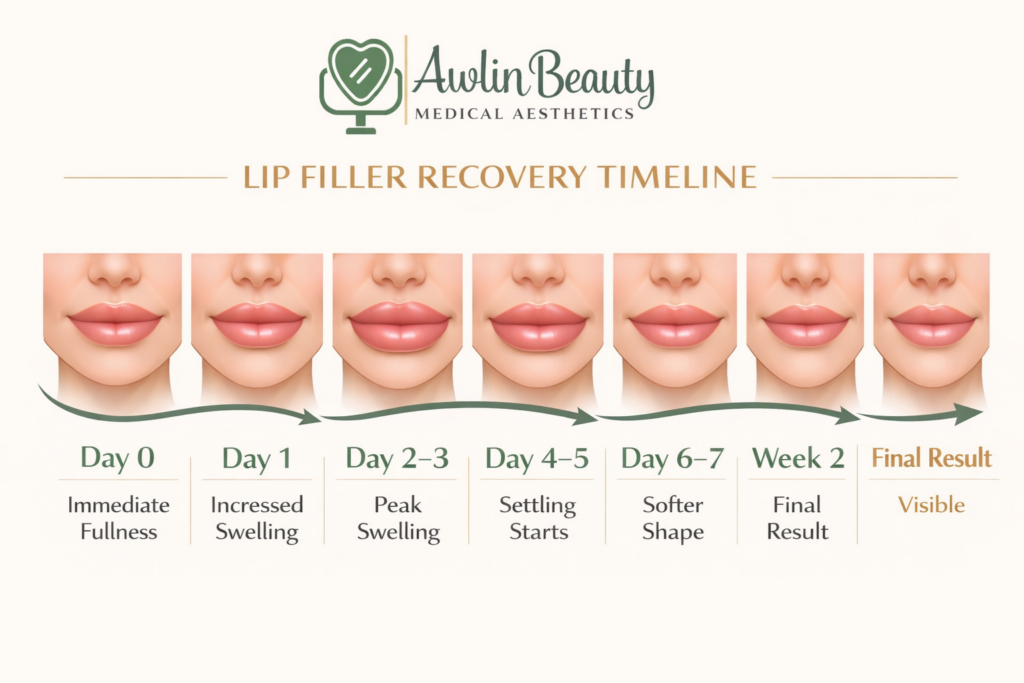
Straight after lip filler, it is normal for the lips to look fuller, firmer and slightly swollen. You may also notice redness at the injection points, a little tenderness, and mild asymmetry in the immediate aftermath. This does not automatically mean anything has gone wrong. It usually means the lips have just been treated.
At this stage, there is a mix of actual filler volume, early inflammation, and minor tissue trauma from the injections. That is why it is too soon to judge shape or size properly. If you have had lip filler for definition rather than obvious volume, the lips can still look temporarily larger than expected on the day of treatment.
For many people, swelling looks more obvious the next morning. The lips may feel tight, a bit tender, and more dramatic than expected. Small bruises may start to show, especially around the border of the lips or where multiple injection points were used.
This is one of the most common stages for people to panic and think their result is “too much”. Usually, it is just the early healing phase. Save Face specifically notes that swelling is often more marked the next morning and that temporary swelling, bruising and tenderness are common side effects after lip filler.
This is often the point where swelling feels at its worst. The lips can look fuller, firmer and slightly uneven. If you bruise easily, bruising may be more visible by now too. One side may look more swollen than the other, especially if the tissue response is uneven. Mild lumps or firmness can also be noticed in the early days, but that does not automatically mean there is a problem.
This is usually the stage where patience matters most. A lot of unnecessary panic happens here because people expect the final result immediately. That is not how lip filler healing works. Awlin Beauty’s lip filler page says swelling often peaks within 24–48 hours, while your current swelling blog also frames the first few days as the most swollen period before improvement starts.
By this point, many clients start to feel more reassured. The lips often look less puffy, the shape begins to appear clearer, and tenderness usually starts to ease. Bruising may still be present, but the swelling is often no longer at its peak.
This is where the lips begin to look more like the intended result, although they may still not be fully settled. It is also normal if there is still some mild unevenness at this stage. Healing is not always perfectly symmetrical, especially in an area that moves as much as the mouth.
Around the end of the first week, many people feel much happier with the way their lips look. The volume usually appears softer, the shape more balanced, and any early overfilled look is often reduced. Bruising may still be fading if you had a stronger bruising response.
That said, one week is better than day two, but it is still not always the final settled result. Some lips hold onto a bit of residual swelling longer than others. This is especially true if you have had more product, naturally reactive tissue, or previous filler in the area.
By around 2 weeks, the lips are usually much closer to their settled appearance. Any temporary swelling should be greatly improved, the filler should feel softer, and it becomes far easier to judge whether the balance, volume and shape are right for you.
This is also the point at which a proper review makes sense. If you are still unhappy at this stage, it is much more useful to assess the result now than in the first few days. Your current swelling blog says results are best assessed after around 2 weeks, and your dissolving page says swelling after dissolving can also take up to 2 weeks for full resolution, which supports the general point that lips should be judged after they have had time to settle
Not everyone swells the same amount, and pretending otherwise is nonsense. Some people swell very little. Others swell noticeably even when the treatment itself has been carried out well.
Factors that can influence swelling include:
This is one reason why a rushed, one-size-fits-all treatment approach is a bad idea. Proper assessment matters. At Awlin Beauty, every lip filler consultation is tailored to your features, goals and starting point, rather than forcing everyone into the same outcome. Your lip filler page specifically states that treatment is tailored to facial features, starting point and aesthetic goals, using carefully selected hyaluronic acid fillers.
These are commonly expected short-term reactions after lip filler:
Save Face lists redness, swelling, bruising, itching and tenderness as temporary side effects after lip enhancement, and notes that bruising can take a week to 10 days to resolve in some cases.
That does not mean you should ignore everything. It means you should not mistake normal healing for a bad outcome. In the first few days, lips can look more dramatic, more uneven, or more swollen than the final result. That is part of the reason aftercare and proper expectations matter so much.
This is where people need to use common sense instead of hoping something serious will magically settle on its own.
Seek urgent medical advice if you experience symptoms such as:
These can be signs of a serious allergic reaction and should be treated as urgent. NHS guidance on anaphylaxis specifically lists throat and tongue swelling, breathing difficulty, swallowing difficulty, wheezing, dizziness and fainting among the warning signs.
You should also contact your practitioner promptly if you have severe pain, unusual skin colour change, worsening swelling rather than improving swelling, or signs that suggest infection or a complication. Not every concern is an emergency, but ignoring red flags is dangerous.
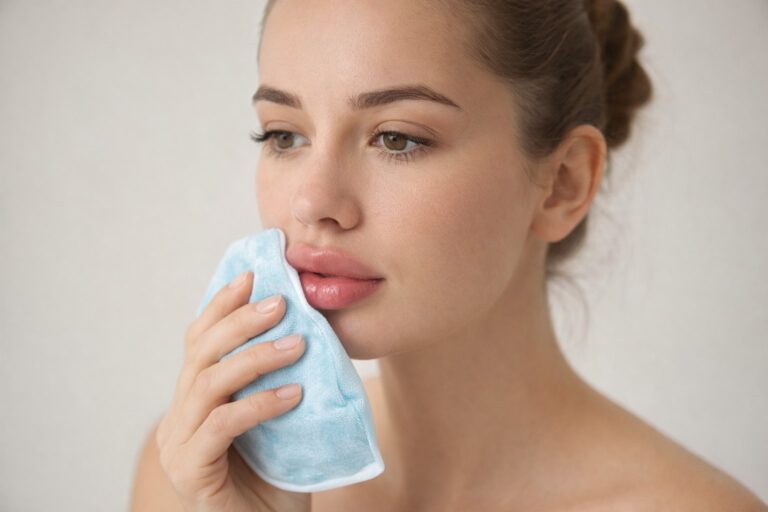
You cannot force lips to heal instantly, but you can avoid making things worse.
Helpful steps include:
A cool compress wrapped in a clean cloth can help soothe the area. Do not put ice directly onto the lips. That is not clever and it can irritate the skin. Advice from aesthetic aftercare sources commonly recommends a cold compress rather than direct ice contact.
For the first night or two, keeping your head a little raised can help reduce fluid build-up and morning puffiness. This is also commonly recommended in aesthetic aftercare guidance.
This matters more than random advice from social media. Proper practitioner-led aftercare is based on the product used, your treatment plan, and how your lips responded on the day.
Heavy exercise, saunas, steam rooms and excess heat straight after treatment can increase blood flow and may make swelling feel worse. Give your lips some chance to settle before going straight back into anything intense. General lip filler aftercare sources advise avoiding intense exercise and heat exposure immediately after treatment.
Constantly pressing, stretching, checking and over-analysing the lips will not help. It usually just irritates the area more.
Yes, mild uneven swelling can be normal in the early healing phase. One side of the lips can respond slightly differently to the other, and the swelling does not always sit evenly at first. That does not automatically mean the final result will be uneven.
The key point is timing.
Unevenness in the first few days is not judged in the same way as unevenness after the lips have settled. If something still looks noticeably off at around 2 weeks, that is the point to review it properly with your practitioner.
These can be signs of a serious allergic reaction and should be treated as urgent. NHS guidance on anaphylaxis specifically lists throat and tongue swelling, breathing difficulty, swallowing difficulty, wheezing, dizziness and fainting among the warning signs.
You should also contact your practitioner promptly if you have severe pain, unusual skin colour change, worsening swelling rather than improving swelling, or signs that suggest infection or a complication. Not every concern is an emergency, but ignoring red flags is dangerous.
Not on the day of treatment. Not the next morning. Not while the lips are at their puffiest.
A much fairer point to assess the result is around 2 weeks, when most temporary swelling has improved and the filler has had time to settle. Your current swelling post says final results are typically assessed after around 2 weeks, and your lip filler page also describes immediate visibility with settled results seen once swelling has reduced.
If you are someone who wants a subtle result, this matters even more. Early swelling can temporarily make subtle lip filler look far more obvious than it will once settled.
First, wait until the lips have actually settled unless your practitioner tells you otherwise. Judging too early creates unnecessary stress and bad decisions.
Second, get proper advice. Sometimes a concern is just lingering swelling. Sometimes it is a volume issue. Sometimes it is historic filler, migration, or an old result that needs a different plan rather than simply “more filler”.
If correction is needed, lip filler dissolving may be the right route for migrated, uneven or unwanted hyaluronic acid filler. Your dissolving page explains that hyaluronidase can be used to safely remove or correct unwanted HA filler, including concerns such as migration, lumps, overfilled lips or previous treatment results you are unhappy with.
Often, yes. Swelling is commonly more noticeable the morning after treatment than immediately after the appointment. Save Face explicitly notes that swelling is often marked the next morning.
The most noticeable swelling is often within the first few days, with visible improvement through the first week. Final judgement is usually best left until around 2 weeks. Awlin Beauty’s lip filler page says swelling often peaks within 24–48 hours and usually subsides over 3–7 days.
Yes, mild bruising can happen after lip filler. Save Face lists bruising as a common temporary side effect and notes that it can sometimes take 7 to 10 days to resolve.
You can support healing with sensible aftercare such as a gentle cold compress, avoiding unnecessary heat, sleeping slightly elevated, and not over-handling the lips. You cannot force instant healing, so stop expecting miracles on day one. General aftercare sources support cold compresses, elevation, and avoiding intense exercise or heat early on.
Not necessarily. Mild uneven swelling in the first few days can be normal. What matters is how things look once the lips have had time to settle.
You should contact your practitioner if you are worried, if swelling is worsening rather than improving, or if you have significant pain, unusual changes, or anything that does not feel right. If you have throat swelling, breathing difficulty or difficulty swallowing, seek urgent medical help immediately. NHS guidance lists these as emergency warning signs.
Yes, hyaluronic acid filler can be dissolved using hyaluronidase in appropriate cases. Your Awlin Beauty dissolving page explains that this may be used for migration, lumps, overfilled lips, asymmetry or returning the lips closer to baseline before future refill treatment.
No. Healing time and swelling response vary from person to person. Lip anatomy, amount of filler, bruising tendency and individual tissue response all make a difference. Your own result should be judged against a sensible healing timeline, not someone else’s filtered photo online. This variation is consistent with the general clinical reality reflected across Awlin Beauty’s recovery guidance and external aftercare sources.
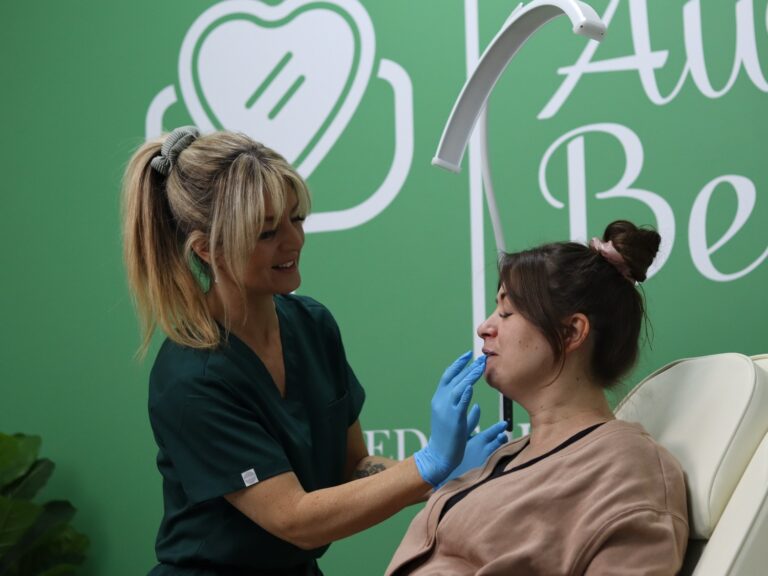
If you are thinking about treatment, it helps to understand healing before you book, not after you panic. Good lip filler should be properly assessed, carefully planned, and delivered in a way that respects your facial balance. At Awlin Beauty, our approach to lip filler in Maidstone is nurse-led, tailored, and focused on natural-looking enhancement rather than overdone results. Your main lip filler page highlights a nurse-led approach, NMC-registered expertise, carefully selected HA fillers, and a focus on soft, balanced lip enhancement.
Whether you want subtle hydration, improved border definition, better symmetry or fuller volume, the right treatment plan matters just as much as the filler itself.
Clare is a registered medical professional with advanced training in aesthetic treatments, ensuring every procedure is performed with clinical precision and safety.
If you are considering natural-looking lip filler in Maidstone, book a consultation with Awlin Beauty to discuss your goals, ask questions, and get honest advice on the most suitable approach for you. We focus on safe, proportionate treatment planning and results that look refined once fully healed.