Confused by smile lines, nose-to-mouth folds or mouth-to-chin lines? Clare explains the difference and when dermal filler may help soften lower face changes naturally.

Lead Practitioner & Director, Awlin Beauty Medical Aesthetics, Maidstone
Most people do not come into clinic knowing the exact name for the lines they are worried about.
They just know what they have started noticing.
A forehead that looks more lined than it used to. A crease between the eyebrows that makes them look annoyed when they are not. Lines around the eyes that suddenly seem more obvious in photos, especially when smiling.
It is usually described in normal, everyday language.
“I look tired.”
“I look tense.”
“I look older than I feel.”
“My face just looks a bit harsher now.”
That’s enough to start with.
You don’t need to know whether the concern is a forehead line, a frown line, crow’s feet, a dynamic line, a static line or a skin quality issue. That is what the consultation is there to work out.
At Awlin Beauty Medical Aesthetics in Maidstone, I look at how your face moves, where the lines sit, what the skin is like, whether the lines are there at rest, and whether an anti-wrinkle consultation in Maidstone would actually be suitable.
Upper-face lines are not all the same. Some are mainly linked to movement. Others are more settled into the skin. Around the eyes, the issue can be less about expression and more about thin, dry or crepey skin.
And not every line needs treating.
Before talking about options, it helps to understand what you are actually seeing.
The easiest way to separate them is by location:
They can all become more noticeable over time, but they involve different movements and different areas of the face.
Now, important point to note is that a line on one person’s face might be caused by strong movement. On someone else, it might be more connected to skin texture, brow position or how the upper face naturally sits. We’re all different and our face shows that in different ways.
Around the forehead and eyes, small changes can alter the whole expression. Treat too much, or treat the wrong area, and the face can look heavier rather than fresher.
I always think of it this way: we are not treating a flat drawing of a face. We are treating a real face that moves.
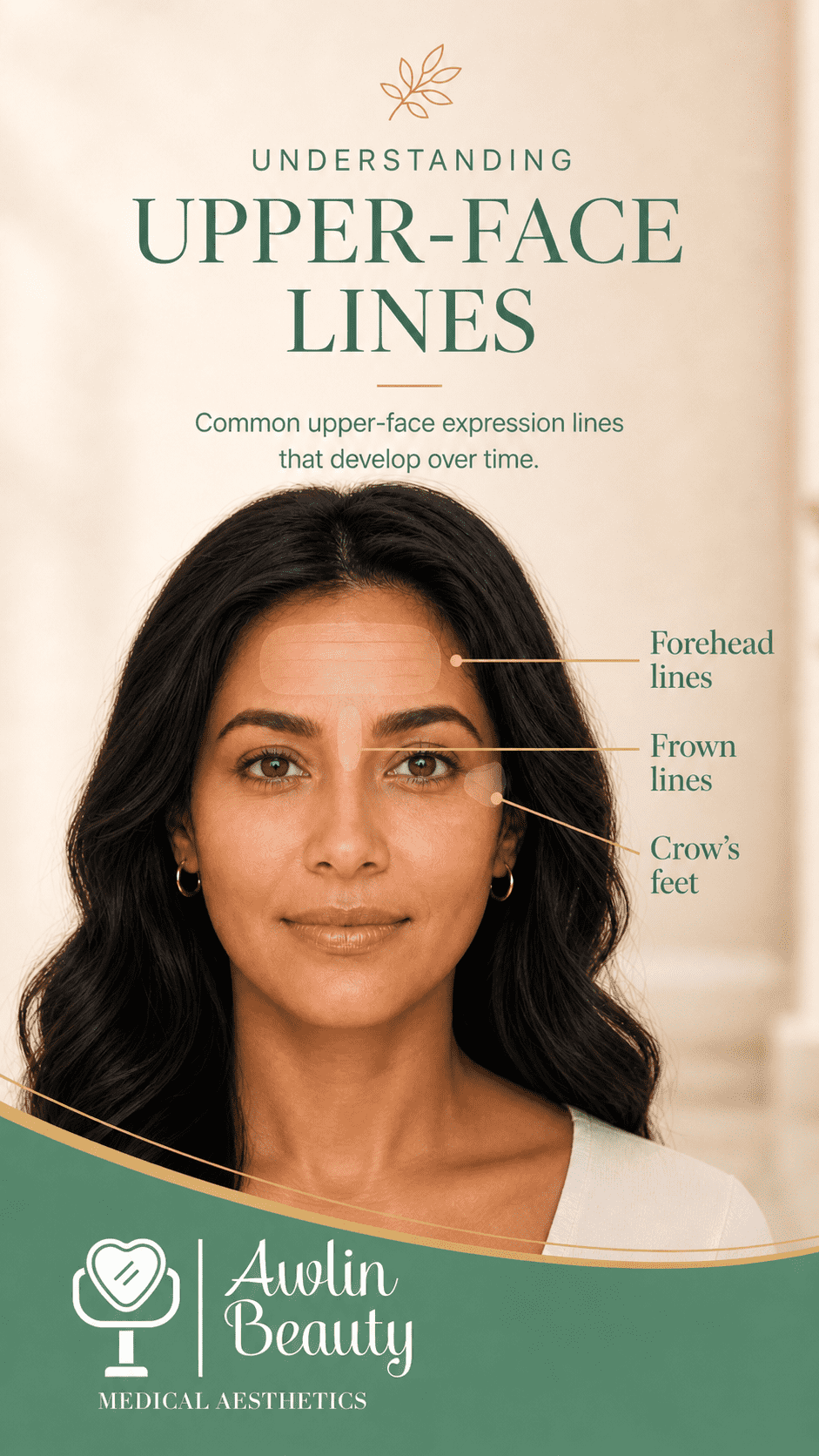
Forehead lines are the lines that run horizontally across the forehead, usually from side to side.
You’ll often see them when you raise your eyebrows. In the beginning, they may only appear during movement. Over time, they can start to stay visible even when the forehead is relaxed.
That’s usually when people begin to notice them more. It might be while doing makeup or under your bright bathroom lighting. It might be in a photo where the forehead looks more lined than it does in the mirror.
Forehead lines can feel hard to ignore because they sit right in the centre of the face. There is nowhere for them to hide.
But I don’t see every forehead line as a problem. Some forehead movement is normal. We lift our brows, react, show surprise, concentrate and use expression all day long. Thats why we look human and not like robots. This is why for some clients their aim is to reduce a line here or there, but we also understand that other clients prefer to make the forehead completely blank.
The question is whether the movement has become stronger than you would like, whether the lines are bothering you, and whether softening that movement would suit your face.
The forehead also has to be treated with care because it helps support the brows. Too much treatment in the area over the brows can result in brows that feel lower and eyes that can look more tired.
That’s why I don’t just look at forehead lines on their own. I look at the forehead, brows, eyelids and frown movement together before giving advice.
Crow’s feet are the lines around the outer corners of the eyes. Cleveland Clinic describes crow’s feet, also known as lateral canthal lines, as fine lines and wrinkles that form on the outer corner of the eyes. They usually show more when you smile, laugh or squint.
I don’t think crow’s feet are automatically a bad thing. A few lines around the eyes can look natural and warm. They are often linked to smiling, and I don’t like the idea that every sign of expression needs to be removed. My husband has strong crows feet when he smiles and he doesnt mind them because he says “They just mean i like to laugh!”
The concern is usually when the lines become more noticeable than someone feels comfortable with, or when the eye area starts to look tired, dry or crepey.
Crow’s feet can be influenced by:
With the eye area, the line itself is not always the whole story. A client may say their crow’s feet bother them, but during assessment the bigger concern may be skin texture.
The skin might look dry, thin or crepey. Makeup may settle. Concealer may crease and the eye area may look tired, even when the person has slept well.
In that case, only looking at movement may not give the result they are hoping for.
For some clients, Lumi Eyes or skin boosters may be worth discussing if the concern is more about skin quality. For others, the concern is mainly expression lines. Many people sit somewhere in between.
The useful part of the consultation is working out which one applies to you.
A lot of upper-face concerns make more sense once you understand the difference between dynamic and static lines. Dynamic lines appear when the face moves.
For example:
Static lines are visible even when the face is relaxed and are usually more established. The skin has started to hold the crease, rather than the line only appearing during movement.
A line that only shows when you move is not the same as a line that is etched into the skin at rest. Deeper lines may still soften, but they usually need more realistic expectations.
This is where the aesthetics industry needs a bit more honesty.
Not every line can be made perfectly smooth. Not every line should be. A face with no movement at all can look strange, and it can quickly start to look overdone. A better aim is softening the area without taking away the expression that makes your face look like yours.
The forehead isn’t an area where more treatment automatically means a better result.
Some people think strong forehead lines need a strong approach. But the forehead helps lift the brows. If that movement is reduced too much, the brows may feel heavier. For someone who already has naturally lower brows or hooding around the eyelids, this can make the eyes look more tired rather than fresher.
So I always want to see how the upper face works together.
Those details change the advice. It’s about what the area is doing, not just about where the line sits.
Frown lines can be frustrating because they affect expression. This isn’t always about wanting to look younger. A lot of people simply do not like the message their face gives off.
They feel relaxed, but they look tense.
They feel fine, but they look annoyed.
They’re not tired, but their face says otherwise.
That knocks confidence, especially at work or in photos, because the face is often the first thing people respond to. The frown area sits right in the middle of expression. Even a small crease between the brows can make the face look more serious.
The goal should not be to remove every bit of character. It should be to soften the tension so the face looks more like how the person actually feels.
There is a big difference between looking rested and looking frozen.
Upper-face lines are not always caused by movement alone. This is especially true around the eyes.
The skin in that area is thinner and more delicate, so dryness, crepiness and dullness can make lines look stronger. Makeup may sit in the creases. The under-eye area can look tired even when you feel well.
If that is the main concern, focusing only on expression may not be enough. Skin quality treatments are different from anti-wrinkle consultations. They’re not designed to stop movement. They are more focused on hydration, freshness and the appearance of the skin.
Lumi Eyes may be discussed for suitable clients concerned about under-eye freshness and delicate skin quality. Skin boosters may also be considered where the concern is broader skin hydration or texture.
The right route depends on what is actually going on, not just the name of the line.
Simply put, No not always.
Having forehead lines, frown lines or crow’s feet doesn’t automatically mean you need treatment.
Some lines are normal. Some suit the face. Some are only obvious to you because you are looking at them closely. Some are better left alone. There are also situations where treatment may not be appropriate. Medical history, certain medications, pregnancy or breastfeeding, active infection, previous complications, or unrealistic expectations can all affect suitability.
There are times when the best advice may be to wait, improve skin health first or to do less than the client originally had in mind.
And yes, there are times when the answer is no.
That isn’t being awkward. It is part of clinical standards and safety approach.
Anti-wrinkle treatments involve prescription-only medicines, so they cannot be treated like a quick beauty add-on. The NHS explains that botulinum toxin injections are prescription-only medicines and can only be prescribed after a consultation with a medical professional. Most clients know these treatments as botox, athough this is just a brand of Anti-wrinkle, like how Nurofen is a brand of Ibruprofen.
An anti-wrinkle consultation is always needed with a prescriber before any decision is made. This is also why responsible clinics need to be careful with how they talk about prescription-only treatments online, rather than advertising them directly to the public.
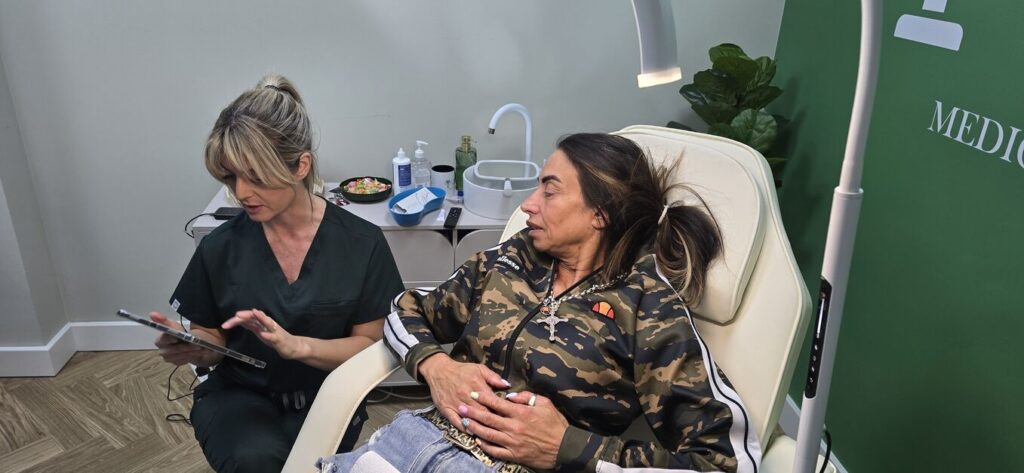
That consultation looks at your medical history, suitability, facial movement, previous treatments, expectations and any risk factors. It also gives you space to ask questions properly, rather than feeling rushed into a decision.
I understand why people want the process to be quick. But with upper-face treatment, quick is not always safe or sensible.
A proper consultation helps avoid unsuitable treatment. It also helps prevent results that look wrong for the person’s face.
Good aesthetics is not just about what can be done. It is about knowing when to pause, when to adjust the plan, and when to leave something alone.
A good result should still look like you. Your forehead shouldn’t feel heavy and your smile shouldn’t look odd. You should still be able to show expression.
For most people, the aim is gentle softening:
If a line is already deep at rest, it may not fully disappear. It can still improve, but it is better to know that from the start.
I don’t want clients chasing a completely smooth face if the trade-off is losing the expression that makes them look natural.
Yes. In fact, they often should be assessed together.
One client may only need advice about the frown area. Another may need the forehead and brow looked at together. Someone else may be better suited to skin quality support around the eyes rather than focusing only on movement.
A friend’s treatment plan is not your treatment plan. A TikTok result is not your face. And a before-and-after photo online cannot show how your muscles move, how your brows sit, or whether your eyes are prone to heaviness. This is one of the reasons why, in the UK, it is illegal to advertise prescription-only medicines (POMs) to the public. Botox, Allergan, Azzalure, and others are classified as POMs.
Your face needs to be assessed in person, while it is moving. That’s the only sensible way to plan treatment around the upper face.
You may want to book an anti-wrinkle consultation in Maidstone if you’ve started noticing changes around the upper face and want proper advice before deciding what to do.
Common reasons include:
You do not need to arrive knowing exactly what you want. It’s usually better to come in open-minded rather than already deciding based on someone else’s result.
Your face may need a different plan.
At Awlin Beauty Medical Aesthetics, my approach is careful, honest and based on natural-looking results.
I don’t try to make every face look the same, but rather look at what suits the person in front of me.
If treatment is suitable, I’ll explain the options clearly and If it’s not right for you, I’ill say so. If expectations need adjusting, we will talk about that properly. If another route makes more sense, I will explain why.
That might sound blunt, but clients deserve honesty.
You are trusting someone with your face. You shouldn’t feel rushed, pressured or talked into treatment you do not understand.
The aim is always to keep results balanced, natural and appropriate for you.
So if you’re unsure whether you are noticing forehead lines, frown lines, crow’s feet or general changes around the upper face, you don’t need to work it out alone.
At Awlin Beauty Medical Aesthetics in Maidstone, your consultation will look at your facial movement, skin quality, suitability and goals before any advice is given.
You may be suitable for treatment. You may be better suited to skin quality support. You may be advised to wait. You may simply need reassurance.
Either way, you will get honest advice before making a decision about your face.
FAQ
Forehead lines run across the forehead and usually show when you raise your eyebrows. Frown lines sit between the eyebrows and are often more noticeable when concentrating, squinting or frowning.
Crow’s feet are the lines around the outer corners of the eyes. They often appear when smiling, laughing or squinting. They are a normal part of expression, although some people choose to get advice when they feel the lines have become more noticeable.
Not always. Lines that mainly appear during movement may soften well. Deeper lines that are visible at rest may not disappear fully. A natural result should soften the concern without making the face look frozen.
Dynamic lines are lines that appear when the face moves. Examples include forehead lines when raising the brows, frown lines when concentrating, and crow’s feet when smiling.
Static lines are visible even when the face is relaxed. They are usually more established and may be linked to repeated movement, ageing, collagen changes and skin quality.
Yes. Some anti-wrinkle treatments involve prescription-only medicines, so an anti-wrinkle consultation is needed to check suitability, medical history, facial movement and whether treatment is appropriate.
That should not be the aim. The goal is usually to soften the area while keeping natural expression. You should still look like yourself.
They may be discussed if the concern is more about skin quality, hydration or crepey texture rather than movement alone. Lumi Eyes or other skin boosters may be suitable for some clients, depending on assessment.
Yes. Awlin Beauty Medical Aesthetics offers anti-wrinkle consultations in Maidstone for clients concerned about forehead lines, frown lines, crow’s feet and other upper-face ageing concerns.
Treatment
For clients who want advice about forehead lines, frown lines, crow’s feet and upper-face movement.
Treatment
For clients concerned about tired-looking under-eyes or delicate skin quality.
Treatment
For clients wanting to support skin hydration, freshness and overall skin quality.
Article
A helpful guide if your concern is more about dullness, texture or hydration than facial movement.
Information
Learn more about our nurse-led, safety-focused approach to aesthetic treatments.