
How long do anti-wrinkle injections last? It’s the question I’m asked at almost every consultation, and the honest answer is more useful than the one most blogs give. “Three to six months” is technically accurate but practically misleading — it’s a range so wide it doesn’t help anyone plan their treatment or understand what to expect. This post gives a more honest picture.
Anti-wrinkle injections are prescription-only medicines. A consultation is required to assess suitability before treatment can be provided.
How anti-wrinkle injections work
Anti-wrinkle injections use botulinum toxin type A — a neurotoxin that causes neuromuscular transmission to fail by blocking the nerve signal from the motor nerve to the neuromuscular junction. In effect, it temporarily prevents specific facial muscles from contracting — a localised, controlled paralysis of the muscles responsible for the expressions that, over time, create lines in the skin above them. Forehead lines, frown lines between the brows, and crow’s feet around the eyes are the most commonly treated areas.
The effect isn’t permanent — the nerve signal gradually returns as the body metabolises the product, and the muscle regains its ability to contract. This is why the treatment needs to be maintained. Results vary between individuals and between treatment areas.
The honest answer on duration
For most people, anti-wrinkle injections last between three and four months. The upper end of the commonly quoted range — five to six months — is real but less typical, and tends to apply to clients who’ve had consistent treatment over a longer period rather than newcomers. Quoting three to six months to a first-time client as though the full range applies equally is unhelpful and often leads to disappointment when the result fades faster than expected.
A more accurate way to think about it: for most clients, plan for around three months between treatments, at least initially. If your results consistently last longer than that over time, you can adjust accordingly. Starting with realistic expectations is better than hoping for the best-case scenario.
The six week peak — and what happens after
Most descriptions of anti-wrinkle treatment focus on when the effect starts and when it wears off. What’s less often discussed is what happens in between — and this is where the clinical picture is more interesting than the marketing materials suggest. Research on botulinum toxin type A peak effect timing indicates that results typically peak at around four to six weeks post-injection, after which there is a gradual decline. How quickly that decline happens is highly individual — which is a large part of why the three to six month range exists at all.
In practice, what this means is that the “best” result from a treatment isn’t necessarily what you see at two weeks — it’s what you see at four to six weeks. From there, the effect gradually softens. Most clients notice the treatment starting to wear off somewhere between eight and twelve weeks, though for some it holds well past that point. Understanding this arc helps manage expectations more honestly than simply quoting a duration range.
Does repeated treatment extend how long it lasts?
There is research suggesting that consistent treatment can increase the duration of the effect over time — and this is something I’ve seen clinically too. A retrospective study of 945 patients receiving at least three consecutive botulinum toxin type A treatments found no loss of effect with repeated treatments, with both patient and provider satisfaction ratings higher after five treatment cycles than after the first. The theory is that the muscle, repeatedly relaxed over time, begins to atrophy slightly — becoming less bulky and less strong — meaning the effect of each subsequent treatment lasts a little longer.
However, the evidence on facial muscle atrophy from cosmetic botulinum toxin type A is limited and nuanced. Research on repeated injections notes that they may cause muscular atrophy in the injected regions, thereby extending the duration of effects — but other reviews note that serial injections can in some cases cause unintended atrophy effects, particularly in larger facial muscles. Most of the atrophy observations are in people having treatment consistently over fifteen to twenty years, and where it does occur at cosmetic doses, it appears to be reversible when treatment is stopped.
From my own clinical experience over the past seven years, I haven’t personally witnessed any facial atrophy in my clients. I’d caveat that honestly — the clients I’ve treated, even those I’ve seen over five to six years, haven’t all been having treatment with complete regularity, so I can’t draw strong conclusions from that. What I would say is that allowing botulinum toxin type A to fully wear off before retreating — rather than topping up early — seems clinically sensible both for minimising any atrophy risk and for avoiding the development of antibodies that can reduce efficacy over time.
What affects how long anti-wrinkle injections last?
Muscle size and strength. Larger, stronger muscles need more product and the effect can decline faster. The glabellar complex — the frown lines — is a large, strong muscle that often needs more units than people expect. Crow’s feet, being a more superficial and finer muscle, typically need less. Getting the dose right for the individual muscle is part of what makes treatment predictable.
Metabolism and individual factors. How quickly each person’s body metabolises botulinum toxin type A varies significantly. High-intensity exercise can increase metabolic rate and may reduce duration — I advise clients to avoid strenuous activity for 24 to 48 hours after treatment. Where someone is in their menstrual cycle may also be a factor for some clients.
Health, medications, and vaccinations. Clinical evidence shows that factors including recent illness, antibiotic use, and vaccination can affect how botulinum toxin type A works — the immune response plays a role in how the body processes the treatment. It’s one of the reasons I ask clients about their recent health history at consultation, and why I’d recommend not booking treatment immediately after being unwell.
UV exposure. There is some limited evidence that significant sun exposure may affect duration, though the research in this specific area is not conclusive. Wearing daily SPF is sensible for many reasons — this is one minor additional consideration.
Treatment history. First-time clients tend to see the result wear off sooner than those with consistent treatment history. This is expected and not a sign anything has gone wrong. With my own clients, I sometimes find that subsequent treatments require slightly more units to achieve a good lasting result — the muscle memory is strong in newer clients, and building a consistent treatment history makes the outcome more predictable over time.
What about static lines — does botulinum toxin type A help?
Botulinum toxin type A works primarily on dynamic lines — those caused by muscle movement. Static lines, which are present at rest and have been etched in over time by years of repeated expression, are a different problem. That said, consistent treatment does help soften static lines over time. If the muscle can’t contract fully, the line can’t deepen further — and with the skin resting more consistently, there’s a chance for some softening of existing creases. It won’t erase them, but it can prevent them from worsening and may gradually improve their appearance. If the treatment lapses, the muscle regains full activity and the line will deepen again.
When does anti-wrinkle treatment kick in?
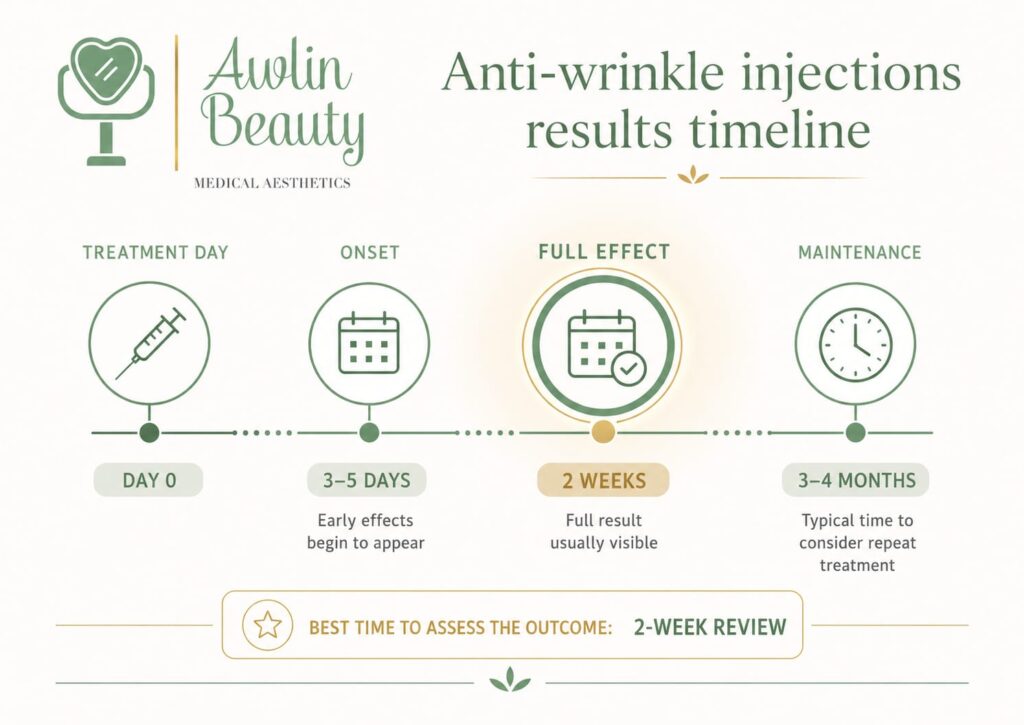
Most clients notice botulinum toxin type A starting to work within three to five days. Full effect is typically visible at two weeks, which is why the two-week review appointment exists — it’s the point at which any areas that haven’t responded fully can be assessed and, if needed, topped up. The peak result, as discussed above, comes at four to six weeks. Results at day two or three aren’t representative of the final outcome.
How often should you have anti-wrinkle injections?
For most people, three to four times a year is the typical maintenance schedule, particularly in the early stages of treatment. As results lengthen with consistent treatment, some clients move to three times a year. Going longer than necessary between treatments — particularly early on — means the muscle regains full strength and the next treatment essentially starts from scratch rather than maintaining the progress made.
The goal of consistent treatment isn’t dependency — it’s efficiency. Maintaining a relaxed muscle is clinically easier and ultimately requires less product than repeatedly treating a muscle that’s had time to fully recover. Many clients who commit to regular treatment find the overall cost and frequency decreases over time.
Anti-wrinkle injections and UK regulations
Botulinum toxin type A is a prescription-only medicine in the UK, which means it can only be legally prescribed and administered by a registered healthcare professional. This regulation exists because botulinum toxin type A carries real risks when placed incorrectly — including eyelid drooping, brow asymmetry, and other complications — and appropriate management requires clinical training.
At Awlin Beauty, Clare is NMC-registered with over 20 years of clinical experience, including specialist training in Oral and Maxillofacial surgery at the Eastman Dental Hospital. Every anti-wrinkle consultation at Awlin Beauty involves a proper assessment of suitability, a discussion of realistic outcomes, and a review appointment at two weeks. If you’d like to discuss whether anti-wrinkle treatment is right for you, you can book a consultation here.