
Lines around the mouth are one of the most common concerns I hear about in consultation. People often come in saying they’ve “noticed their mouth area has aged” — and when we look more closely, there’s usually a specific type of line driving that, even if they haven’t been able to name it. Getting that right matters, because different lines have different causes and respond to different treatments.
This post walks through the three main types of lines that form around the mouth, what causes each of them, and what can realistically be done without surgery. I’ll also explain why a combination approach is often more effective than filler or anti-wrinkle injections alone.
Three types of lines around the mouth — and why they’re different
The phrase “lines around the mouth” gets used as a catch-all, but it actually covers three distinct types of line — each with its own cause, location, and most appropriate treatment. Knowing which you’re dealing with is the starting point for any honest treatment discussion.
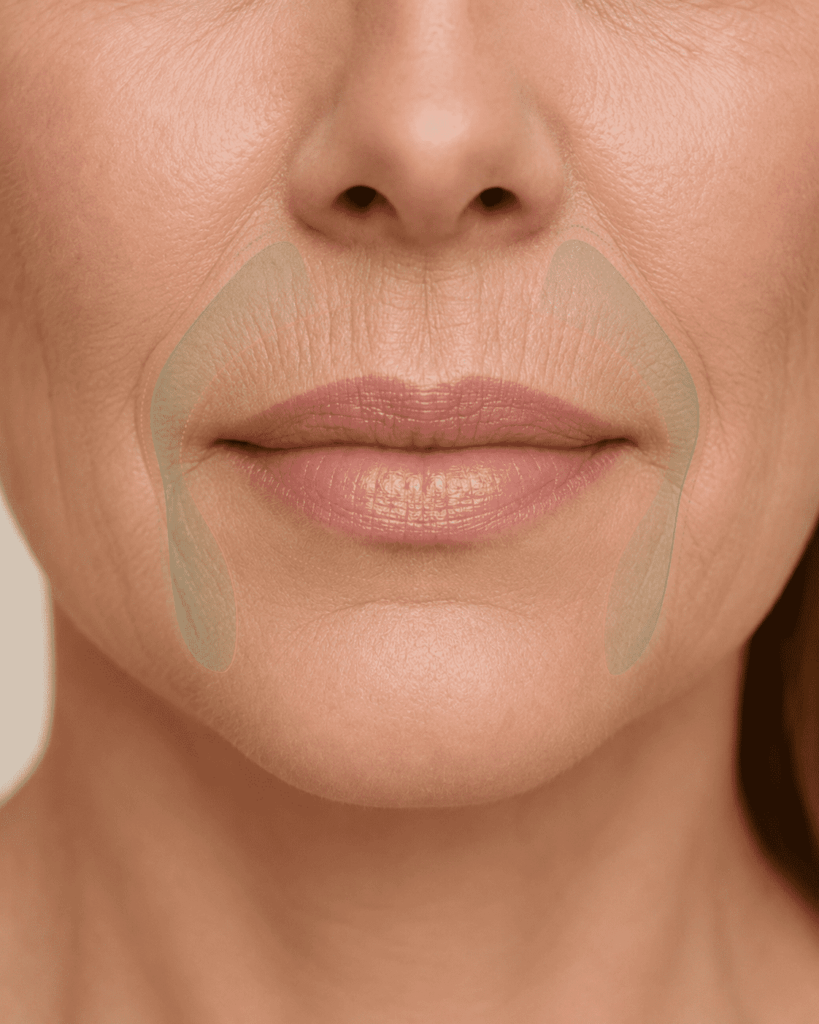
Perioral lines (also called barcode lines or smoker’s lines) are the fine vertical lines that run upward from the top lip — and sometimes below the lower lip too. They sit in the skin itself rather than as deep folds, and they become more visible when wearing lipstick, which tends to bleed into them. These are primarily caused by skin thinning, collagen loss, and repeated contraction of the orbicularis oris muscle around the mouth.
Nasolabial folds (smile lines) run from the sides of the nose down to the corners of the mouth. These exist in everyone to some degree and are a normal feature of facial anatomy. With age, the mid-face loses volume and the skin descends, causing these folds to deepen from a subtle contour into a more prominent crease. They’re primarily a volume and structural issue rather than a skin texture one.
Marionette lines run downward from the corners of the mouth toward the chin — the lines that give the impression of a turned-down expression or a puppet’s jaw. These develop as a result of volume loss in the lower face, descent of the cheek tissue, and the natural downward pull of gravity over time. They can make people look sad or tired even when they aren’t, which is often what brings clients in.
Many people have more than one of these at the same time, and the same area of the face can be affected by overlapping causes. That’s why assessment at consultation looks at the lower face as a whole — not just at one line in isolation.
What actually causes lines around the mouth?
Several factors drive the development of mouth lines, and most people have a combination of them working simultaneously. Understanding the cause helps clarify what treatment can and can’t address.
Collagen and elastin loss. From our mid-twenties, the skin produces less collagen each year. Collagen provides structural support and keeps skin firm; elastin allows it to bounce back after movement. As both decline, the skin around the mouth — which is thin and highly mobile — becomes more susceptible to creasing and fine lines forming permanently.
Repeated muscle movement. The orbicularis oris muscle contracts constantly — when speaking, eating, sipping, smiling, kissing. Clinical research shows that women tend to develop perioral lines earlier and more severely than men, partly due to differences in perioral muscle structure and a lower density of sebaceous glands in this area — which means less natural oil to buffer the skin against repeated folding.
Volume and bone loss. With age, both soft tissue volume and the underlying bone structure of the face reduce. The jaw bone gradually loses density, and the fat compartments of the lower face descend and deflate. This causes skin that was previously supported to sag or fold — which is why marionette lines and deepening nasolabial folds are largely a structural rather than a surface problem.
UV exposure. Sun damage accelerates collagen breakdown and causes photoageing — a distinctive pattern of fine crepey lines that affects texture across the perioral area. Daily SPF is one of the most clinically supported preventive steps anyone can take.
It probably isn’t because you smoked
I see clients regularly who are embarrassed about their upper lip lines because they assume it signals a history of smoking. It’s worth being direct about this: perioral lines are not caused primarily by smoking. They develop in non-smokers just as commonly, driven by the same combination of muscle activity, collagen loss, and skin thinning that affects everyone.
Smoking does accelerate the process — the repetitive lip pursing and the impact of tobacco toxins on collagen both contribute. But the lines themselves are a normal part of facial ageing, not a badge of a particular lifestyle. The “smoker’s lines” label has stuck culturally in a way that causes unnecessary self-consciousness, and it often stops people from seeking treatment they might genuinely benefit from.
What non-surgical treatments can help?
The appropriate treatment depends on which type of line you have, how deep it is, what’s causing it, and what outcome you’re looking for. There’s no single answer, and I’d be cautious of any post or clinic that suggests there is.
It’s also worth noting that anti-wrinkle injections are sometimes offered for perioral lines elsewhere. At Awlin Beauty, I don’t offer this — the risk of affecting natural lip movement and speech in this area isn’t one I’m willing to take with my clients. Filler, placed correctly, gives reliable results here without that compromise.
Perioral lines filler. Small, precise amounts of perioral lines filler placed directly into the fine vertical lines above the lip can soften their appearance significantly. This isn’t the same as lip filler — the product used and the placement are quite different. The goal is to support the skin from within without adding visible volume to the lips themselves, though a subtle improvement to the lip border often occurs as a secondary effect.
Nasolabial folds filler. For smile lines that have deepened with age, nasolabial folds filler restores the volume that has been lost, softening the fold rather than simply filling the crease. Results vary depending on the depth of the fold and the underlying cause — superficial or mid-depth folds tend to respond well; very deep structural folds may require a combination approach or a realistic conversation about what’s achievable.
Marionette lines filler. Marionette lines filler supports the corner of the mouth and restores volume to the lower face, reducing the downward pull that creates the puppet-line appearance. As with nasolabial folds, addressing the chin and jawline at the same time often gives a more balanced result.
The vermillion border — and why it often matters more than the lines
One thing I notice consistently in consultations for perioral lines is that the lines themselves aren’t always the biggest driver of how aged the area looks. More often, it’s the loss of the vermillion border — the defined edge that gives the lip its shape and creates a clean transition between the lip and the skin above it.
As the border flattens and loses definition with age, the upper lip can start to look like it’s disappearing into the surrounding skin. Lipstick bleeds because there’s no longer a crisp edge to contain it. The whole mouth area looks less defined — and this is frequently what people are actually responding to when they say their lips look “older,” even if they can’t identify exactly why.
Restoring the vermillion border with a small, precise amount of filler — without adding volume to the body of the lip — can make a significant difference to how the whole perioral area reads. In many cases it gives a more noticeable improvement than treating the fine lines directly.
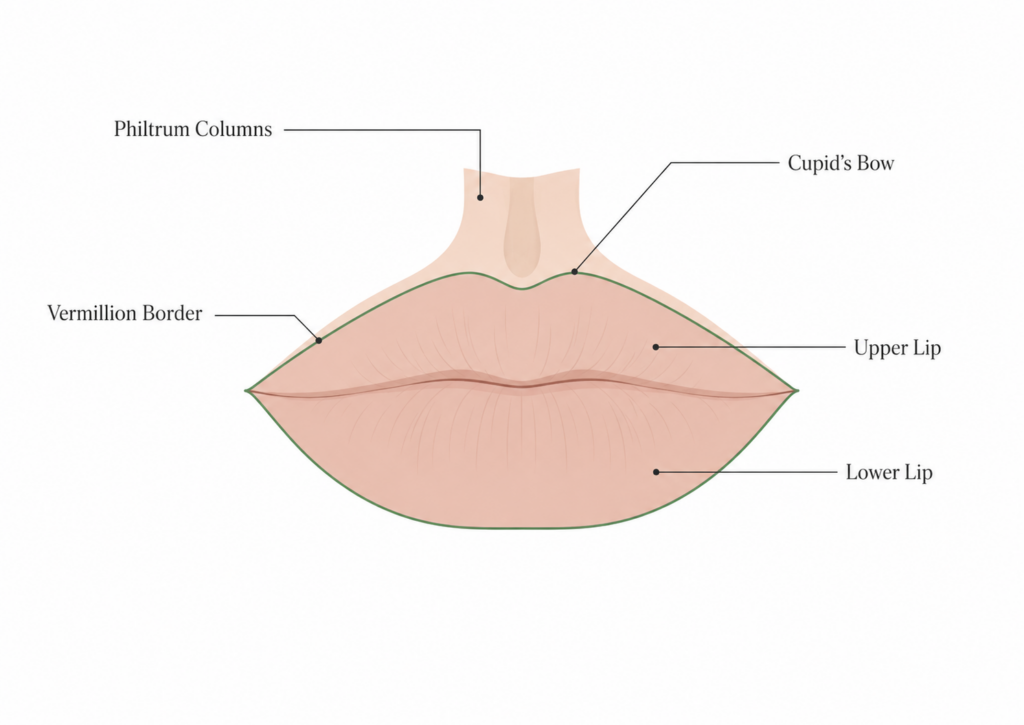
It’s a conversation I have regularly in consultations, particularly with mature ladies who come in specifically about perioral lines. Once I explain that some filler placed along the vermillion border and cupid’s bow can provide the scaffolding that supports the perioral treatment — and that lines very often encroach into the lip itself, which most people don’t realise until I show them — it reframes the whole approach. The filler works better when it’s linked; treating the border helps the flow into the perioral lines rather than addressing each area in isolation.
One client told me after her treatment that she looked a lot less melancholy — she’d felt her lips had been looking very pursed for a while but hadn’t connected that to volume loss along the border until we addressed it. That reaction stays with me, because it captures something that’s hard to explain before treatment: sometimes the thing that’s ageing an area most isn’t the lines at all.
This is quite different from lip filler in the traditional sense. It isn’t about making the lips bigger — it’s about restoring the architecture that was there before. Whether border definition, line treatment, or both is appropriate depends entirely on what’s assessed at consultation.
What treatment can’t do
Aesthetic treatment can soften lines significantly, but it doesn’t reverse the underlying ageing process or permanently rebuild collagen. Deeply etched perioral lines — particularly those caused by decades of sun damage or significant skin thinning — can be improved but rarely eliminated entirely. Managing expectations honestly is part of any good consultation.
Skincare plays a supporting role too. Daily SPF, a retinoid if tolerated, and good hydration all help maintain skin quality between treatments and slow the rate at which lines develop further. Treatment and skincare work better together than either does alone.
Choosing a practitioner for perioral treatment
The perioral area is one of the more technically demanding areas to treat with filler. The tissue is thin, the muscle is active and complex, and the aesthetic margin between a natural result and an overdone one is narrow. Since 2023, UK law requires dermal filler treatments to be carried out or overseen by a registered healthcare professional — a change that was long overdue.
When looking for a practitioner, always check that they have specific experience with perioral treatment rather than just general filler experience. At Awlin Beauty, Clare is NMC-registered with over 20 years of clinical experience and specialist training in Oral and Maxillofacial surgery — which means a particular depth of anatomical knowledge in exactly this area of the face.
If you’d like to discuss what’s causing the lines around your mouth and whether treatment is appropriate, you can book a consultation at Awlin Beauty here. There’s no commitment to proceed — it’s an assessment first.