

Marionette lines — the folds that run downward from the corners of the mouth toward the chin — are one of the lower face changes that clients find most ageing. They can create a permanently sad or stern expression even when the face is relaxed, which is often what makes people start thinking about treatment. But marionette lines aren’t all caused by the same thing, and understanding what’s driving them in your case makes a significant difference to what treatment will and won’t achieve.
This post explains what causes marionette lines, how marionette lines filler works, why a muscle called the DAO can be a factor that filler alone won’t address, and what a realistic result looks like.
What are marionette lines?
Marionette lines are the vertical folds that form at the corners of the mouth and run downward toward the chin. The name comes from the hinged jaw of a marionette puppet — the lines create a similar visual effect, giving the impression of a face that’s divided into sections. They’re distinct from nasolabial folds, which run from the nose to the corners of the mouth; marionette lines start at the mouth corners and go downward.
Like most lower-face changes, they’re a normal part of ageing — but the degree to which they develop and how early they appear varies significantly between individuals depending on anatomy, skin quality, and muscle activity.
What causes marionette lines?
Volume loss and fat pad descent. With age, the fat compartments of the mid and lower face lose volume and descend, reducing the structural support that previously kept the lower face lifted. As this support diminishes, the corners of the mouth are no longer held in their youthful position and begin to droop, deepening the fold below.
Collagen and elastin loss. The skin thins and loses elasticity with age, meaning it no longer bounces back from the constant movement of the lower face. The fold becomes a permanent crease rather than a dynamic one.
Bone resorption. The mandible gradually loses density with age, reducing the skeletal foundation of the lower face. Less bone means less support for the overlying soft tissue, contributing to the descent that deepens marionette lines over time.
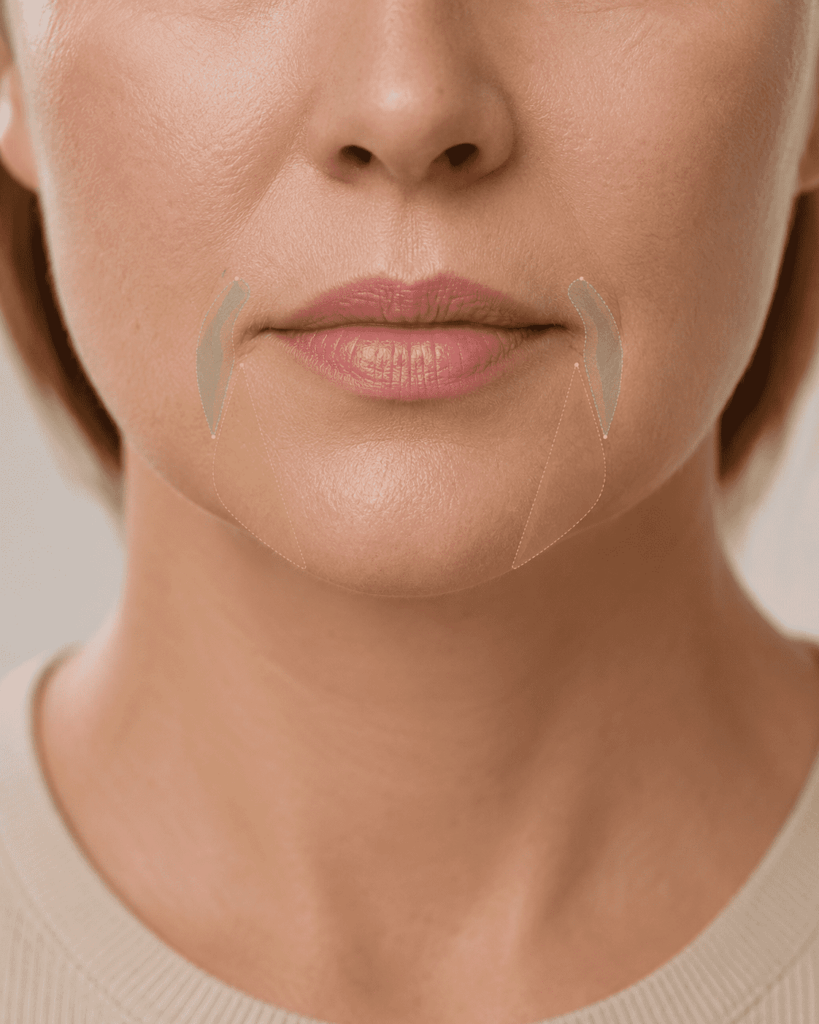
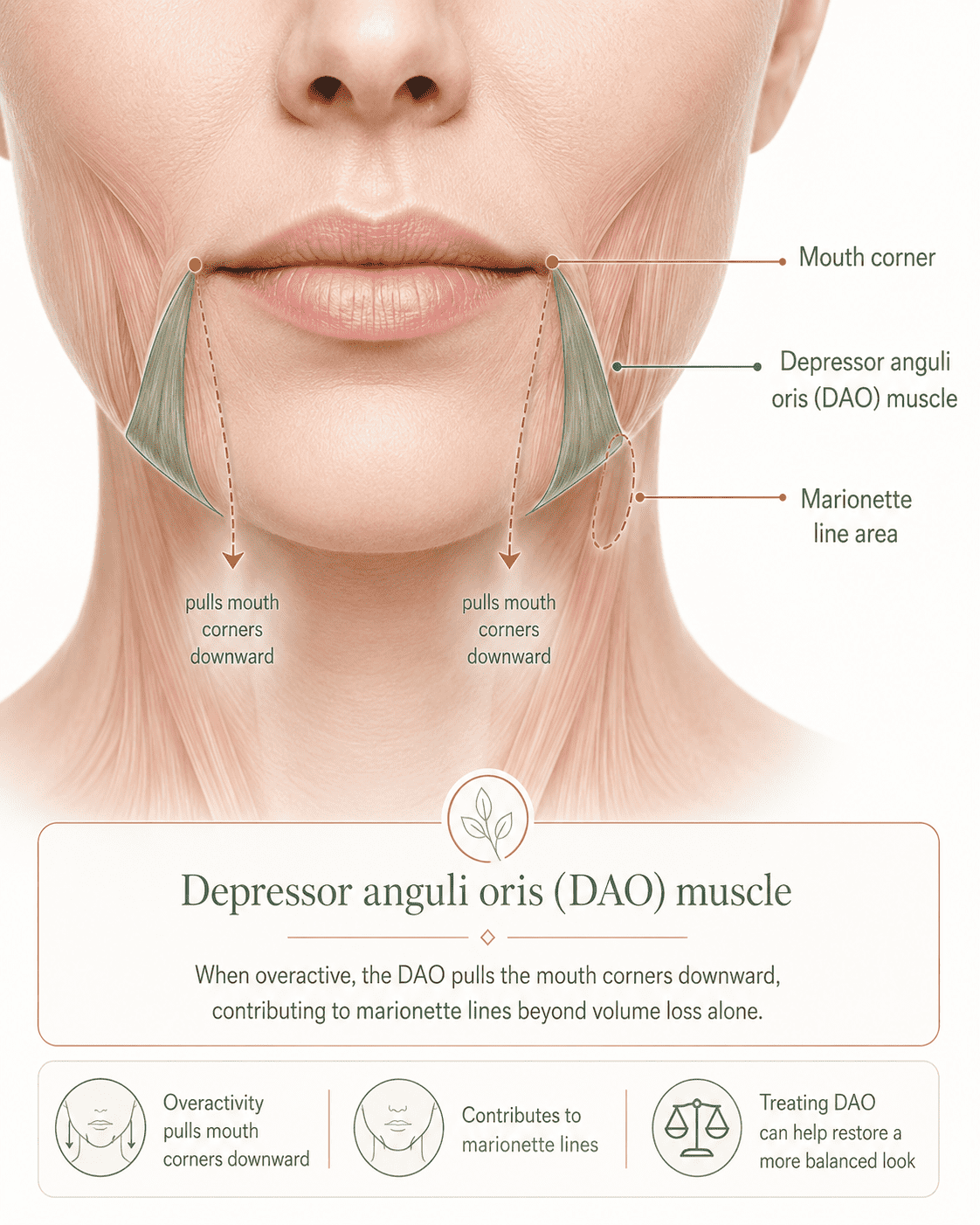
The DAO muscle. The depressor anguli oris — the muscle that actively pulls the corners of the mouth downward — plays a role that’s often overlooked. In some clients, an overactive DAO is actively contributing to the downturned appearance at the corners of the mouth, compounding the effect of volume loss. Where this is the case, the treatment approach needs to reflect it.
What type of marionette lines do you have?
Not all marionette lines are the same, and the distinction matters for treatment planning.
Volume-driven marionette lines develop primarily because structural support in the lower face has diminished — fat pad descent, bone loss, and skin laxity are the main drivers. The fold is present at rest and has deepened over time. Filler placed into and around the fold addresses the volume deficit directly, supporting the tissue and softening the crease. This is the most common presentation and the one where filler alone typically gives a good result.
Muscle-driven marionette lines involve an overactive DAO pulling the corner of the mouth downward. These clients often notice a persistently downturned mouth expression — looking sad or stern even when they’re not — that is at least partly caused by muscle activity rather than volume loss alone. In these cases, the treatment approach needs to address both the volume deficit and the muscle activity for a complete result.
Many clients have elements of both, which is why assessment at consultation looks at the lower face as a whole rather than just the fold itself.
The DAO muscle — and why it matters more than most people realise
The depressor anguli oris (DAO) sits on either side of the lower mouth. As we age, it can become hyperactive — pulling the corners of the mouth downward and creating folds in the muscle layer that eventually show on the surface of the skin. These folds are what we know as marionette lines. Some clients describe a look of sadness or even grimacing that they can’t seem to shift, even when they feel fine. That’s often the DAO at work.
The treatment approach depends entirely on how active the muscle is and whether the lines are dynamic or static.
Where the DAO is active but the lines are still relatively fine, filler is a good option — and I’ve actually found that skin boosters can work really well in this area. When the muscle isn’t so overactive that it’s created very deep folds, the skin booster’s regenerative effect combined with the therapeutic stimulus of the needles penetrating the skin can give a smoother, fuller look. It’s an option that surprises people but works well in the right presentation.
Where the DAO is genuinely hyperactive and pulling downward significantly, using skin boosters or filler on this area won’t make the difference you would expect. instead, by playing small anti-wrinkle injections in these areas, it can stop that muscle from pulling downward to prevent the crease from developing further. This would soften the existing lines over time by temporarily stopping the muscle action driving them. Anti-wrinkle injections are prescription-only medicines. A consultation is required to assess suitability before treatment can be provided.
However, and this is important, if the lines are already static meaning they’re present at rest and have been etched in over years of muscle activity, then stopping the muscle won’t erase what’s already there. In cases such as those, filler or a skin booster is still needed to address the existing lines directly.
Anti-wrinkle treatment is most effective as prevention or early intervention, not as a correction for lines that are already well established.
In my experience, the clients who come to me with marionette lines tend to be mature ladies — often in their fifties, sixties, and beyond. And by that stage, anti-wrinkle treatment frequently doesn’t achieve very much on its own. What these clients are generally looking for is softer lines, and what I’ve found works well for them is a combination of dermal filler and skin booster used together in this area. It’s not a one-treatment-fixes-everything situation, and it’s not a one-off either — maintenance is part of managing the result over time. But the improvement is genuinely achievable, and the consultation is where the right approach for each individual gets established.
How does marionette lines filler work?
Hyaluronic acid filler is placed into and around the marionette fold to restore the volume that’s been lost and support the overlying tissue. The product is typically placed at multiple depths — deeper placement for structural support, shallower for surface softening — using either a needle or a cannula depending on the anatomy and the practitioner’s preferred technique.
Results are visible immediately, though the final outcome settles over two weeks as any initial swelling resolves and the filler integrates with the surrounding tissue. The improvement tends to look like a more rested, less stern version of the face rather than a dramatically different one — which for most clients is exactly the right outcome.
Should marionette lines be treated in isolation?
Rarely. Marionette lines are almost always part of a broader lower-face picture — they develop alongside nasolabial folds, jowling, and changes to the chin and jawline, all driven by the same underlying structural changes. Treating marionette lines in isolation without considering the surrounding areas can give an unbalanced result, because the fold has been softened but the rest of the lower face hasn’t been addressed.
At consultation, I look at how the marionette lines relate to the nasolabial folds, the jawline, and the chin. Sometimes treating one area meaningfully improves another — restoring cheek volume, for example, can soften marionette lines as a secondary effect by lifting the tissue above them. The right approach depends on what’s actually driving the concern in each individual case.
How long does marionette lines filler last?
Typically between nine and twelve months when placed directly into the fold, which is a higher-movement area. Deeper structural placement tends to last longer — toward twelve to eighteen months — because it experiences less mechanical stress from facial movement. Results vary between individuals depending on metabolism, skin quality, and the volume used.
Hyaluronic acid filler is fully dissolvable using hyaluronidase if needed. At Awlin Beauty I use only hyaluronic acid — the reversibility matters particularly in the lower face, where placement precision is important and the ability to adjust the result is a meaningful safety consideration.
Choosing a practitioner for marionette lines treatment
The lower face involves important vascular structures, and marionette line treatment in particular requires an understanding of the DAO muscle and its relationship to the surrounding anatomy. Since 2023, UK law requires dermal filler treatments to be performed or overseen by a registered healthcare professional. For a technically nuanced area like this, that clinical background matters.
At Awlin Beauty, Clare is NMC-registered with over 20 years of clinical experience, including specialist training in Oral and Maxillofacial surgery at the Eastman Dental Hospital. If you’d like to discuss whether marionette lines treatment is right for you, you can book a marionette lines consultation at Awlin Beauty here. Assessment always comes before any treatment recommendation.