

Nasolabial folds — the lines that run from the sides of the nose down to the corners of the mouth — are one of the most common concerns people bring to consultation. They’re also one of the most misunderstood, because what looks like a surface line is very often a structural problem. And that distinction matters enormously when it comes to treatment.
This post explains what actually causes these folds to deepen, whether filler can help, and — perhaps more usefully — why where the filler goes makes as much difference as whether you have it at all.
What are nasolabial folds?
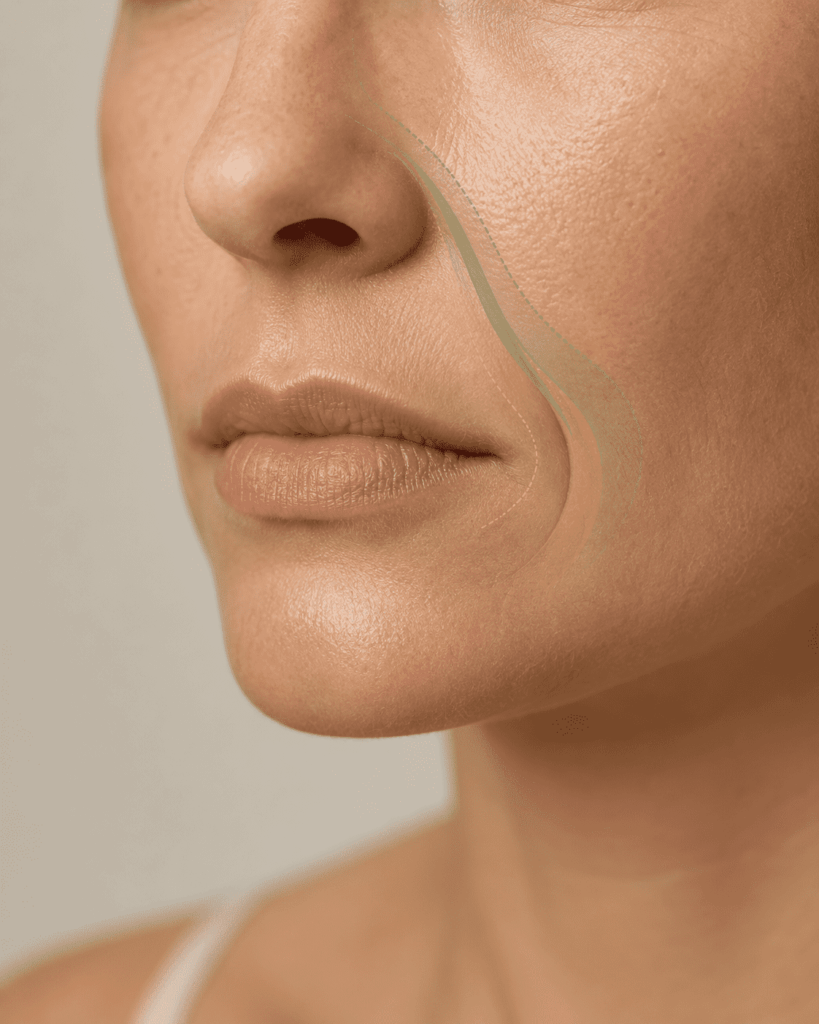
Nasolabial folds are the creases that run from each side of the nose down to the corners of the mouth. They’re a normal part of facial anatomy — everyone has them, even in youth. When you smile, the muscle movement creates a fold in this area; that’s entirely natural and not something that should be treated. The concern arises when the fold becomes visible and prominent at rest, when you’re not smiling at all.
At that point, the fold has moved from a dynamic feature of facial expression to a static crease — and that shift is driven by structural changes in the face, not just the skin itself.
What causes nasolabial folds to deepen?
Several factors contribute, and most people have a combination of them working simultaneously.
Mid-face volume loss and descent. The fat compartments of the mid-face — which sit high in youth, giving the cheeks their fullness and lift — gradually lose volume and descend with age. Clinical research has shown that this mid-face descent is one of the primary drivers of nasolabial fold deepening — as the cheek tissue drops, it piles up above the fold and the crease below becomes more pronounced. This is a structural issue, not a skin one.
Collagen and elastin loss. From the mid-twenties, the skin produces less collagen each year. As structural support decreases, skin that was previously held in position by a firm, elastic framework begins to sag. The nasolabial area — where a significant amount of facial movement occurs — is particularly susceptible to this.
Repeated facial movement. Smiling, talking, eating — the muscles around the mouth contract thousands of times a day. Over decades, this repeated folding of the skin in the same place contributes to the crease becoming permanent rather than dynamic.
Bone resorption. The facial skeleton changes with age too. The maxilla — the bone that forms the base of the mid-face — gradually loses density, reducing the foundation on which the overlying soft tissue rests. Less skeletal support means more tissue descent, which deepens the fold further.
UV exposure and lifestyle. Sun damage accelerates collagen breakdown and contributes to skin laxity. Smoking similarly degrades collagen and reduces skin quality. Daily SPF is one of the most clinically supported steps anyone can take to slow this process.
Nasolabial folds in your 20s — they’re probably not a problem
I see clients in their early to mid-twenties who are concerned about nasolabial folds, often because they’ve noticed them in photos or video calls. I want to be direct here: nasolabial folds at this age are almost always entirely normal. They become visible when you smile because that’s what faces do, and in the vast majority of cases they’re not visible at rest — which is the clinical threshold for treatment being appropriate.
Treating nasolabial folds aggressively in younger clients — before there’s genuine volume loss or structural change driving a static crease — is something I’d caution against strongly. Filler placed early and repeatedly in this area can flatten the natural contour of the face and produce an unnatural result that becomes harder to manage over time. The right answer for most people in their twenties is honest reassurance, not treatment.
Managing expectations — and the facelift conversation
One of the most common things I see in consultations for nasolabial folds is a client placing their hands against their cheeks and pulling the skin upward. “I want it to look like this,” they say. It’s a very human response — they’re showing me exactly what’s bothering them. But I have to stop them there and be honest, because what they’re describing is a facelift.
Filler cannot give you that. If a significant lift is what you’re looking for, you’re better off saving your money and having a surgical consultation, because no amount of filler will replicate what a facelift achieves. What I can do is soften the lines that are bothering you — and for many clients, that’s genuinely enough. But the distinction matters, and setting that expectation clearly at consultation is part of treating people properly.
When significant weight loss is involved
Some clients come in with deep nasolabial folds following significant weight loss. When that’s the case, addressing the folds in isolation won’t do very much at all — because the underlying issue is generalised volume loss across the face. What’s needed is a fuller facial consultation: cheeks, nasolabial folds, and potentially the jaw and chin line together. That approach won’t solve the folds entirely, but it creates the illusion of a fuller, softer face overall — one that looks less aged rather than a face where one area has been treated and the rest hasn’t caught up.
Should filler go into the fold — and how?
The nasolabial area is one of the more technically demanding areas to inject. The facial arteries run literally alongside these folds, which means depth of injection is critically important. Vascular occlusion — where filler enters a blood vessel — is a rare but serious complication, and this is one of the areas where the risk is most relevant. It’s exactly why the practitioner’s anatomical knowledge matters as much as their aesthetic eye.
Rather than injecting hyaluronic acid filler directly into the fold, I often use a cannula approach — placing microdroplets just alongside the fold rather than into it. This offers greater structural support, reduces the vascular risk associated with needle injection in this area, and gives a more refined, natural result. It’s one of several reasons why technique matters as much as the product used.
The choice of filler also varies depending on the individual. For most clients I would typically use a Revolax Sub-Q — a denser product suited to deeper structural placement. For older clients or different presentations, a different product may be more appropriate. That decision is made at consultation based on what’s assessed, not assumed in advance.
The pyriform fossa — the area most people don’t know about
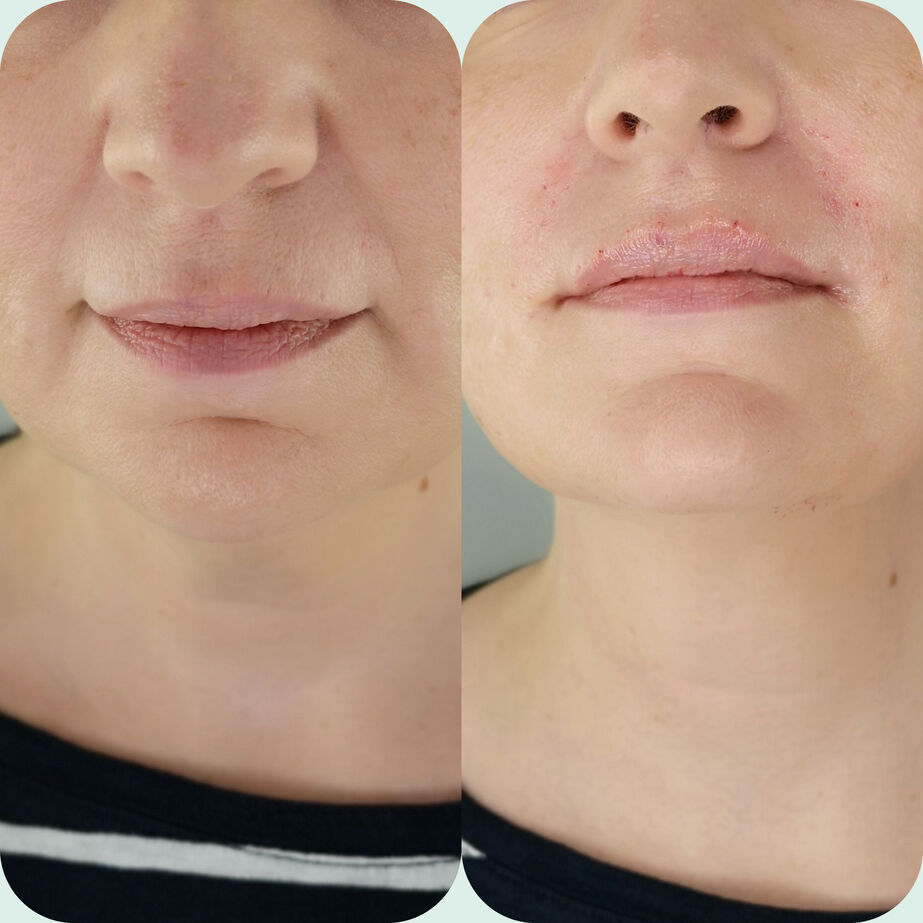
There’s a specific area that makes a significant difference to deeper nasolabial folds that rarely gets discussed: the pyriform fossa — the small recess beside each nostril. When the nasolabial fold is particularly deep at the top, where it meets the nose, this is often because volume has been lost right at that point. By placing a small amount of filler deep against the bone in the pyriform fossa, the deeper wedge at the top of the fold lifts naturally. It doesn’t take much product, but the effect on the upper fold is often more noticeable than anything placed further down the line.
This is the kind of detail that separates a treatment plan built around your specific face from a generic approach. Whether addressing the mid-face above, the fold itself, the pyriform fossa, or a combination of all three is what the consultation is for — there’s no single formula that works for every face.
Can filler really help nasolabial folds?
For most people, yes — when treatment is approached correctly. Moderate nasolabial folds driven by volume loss and mid-face descent typically respond well, either through direct fold correction, mid-face support, or a combination. The fold won’t be made invisible — it’s a natural anatomical feature — but it can be softened meaningfully, making the face look more rested without appearing treated.
Very deep folds — particularly those driven primarily by significant skin laxity rather than volume loss — are harder to correct with filler alone. Where skin laxity is the main driver, filler can improve the appearance but may not give the result someone is hoping for, and being clear about that at consultation is part of treating people honestly. In those cases, a combination approach or a different treatment altogether may be more appropriate.
How long does nasolabial fold filler last?
When placed directly into the fold, filler typically lasts between nine and twelve months — this is a high-movement area and the product breaks down faster than in less mobile zones. When the treatment approach involves mid-face support, results often last longer because the filler is placed more deeply and experiences less mechanical stress. Results vary between individuals depending on metabolism, skin quality, and the volume used.
Hyaluronic acid filler is fully dissolvable using hyaluronidase if needed. At Awlin Beauty, I use only hyaluronic acid — it’s the safest option and gives both practitioner and client the ability to adjust or reverse the result if anything needs to be addressed.
What about nasolabial folds and marionette lines together?
Nasolabial folds and marionette lines often develop at the same time and for the same underlying reasons — mid-face descent, volume loss, and reduced structural support in the lower face. Treating both together as part of a lower-face assessment frequently gives a more balanced result than addressing one in isolation, because they’re driven by the same structural changes.
If you’re considering nasolabial fold treatment, it’s worth discussing the lower face as a whole at consultation rather than requesting one specific area. What you’re noticing about your nasolabial folds may be part of a broader picture that’s better addressed holistically.
If you are also concerned about fine lines around the mouth, our perioral lines filler treatment in Maidstone addresses vertical lip lines and smoker’s lines as a separate or complementary treatment.”
Choosing a practitioner for nasolabial fold treatment
The nasolabial area involves important vascular structures and sits adjacent to the mid-face, where an understanding of deeper anatomy matters significantly. Since 2023, UK law requires dermal filler treatments to be performed or overseen by a registered healthcare professional. For an area as technically nuanced as this one, that clinical background is particularly relevant.
At Awlin Beauty, Clare is NMC-registered with over 20 years of clinical experience, including specialist training in Oral and Maxillofacial surgery at the Eastman Dental Hospital. Lower-face and mid-face anatomy is an area she knows in considerable depth. If you’d like to discuss whether nasolabial fold treatment is right for you, you can book a consultation at Awlin Beauty here — assessment always comes before any treatment recommendation.