
Jawline filler is one of the most requested treatments in aesthetics right now — and also one where expectations don’t always match what the treatment can realistically deliver. Most content about it focuses on dramatic contouring results for younger faces, which doesn’t reflect the majority of clients I see. Understanding what it actually does, and for whom, is the most useful starting point before considering whether to book.
This post explains how jawline filler works, the two quite different groups of people it suits, what it can realistically achieve for jowls, and when I’d advise someone to think carefully before going ahead.
What is jawline filler?
Jawline filler is a dermal filler treatment — typically hyaluronic acid, a substance naturally present in the body — injected along the mandible (the jawbone) to define, contour, or restore the lower face. The product is placed at specific points along the jaw, usually deeply against the bone, to add structure, sharpen the border between the jaw and the neck, or restore volume that has been lost with age.
It’s a technically demanding area. The jawline involves important anatomical structures — blood vessels, nerves, and the masseter muscle — and placement depth and position matter significantly. The margin between a result that looks clean and natural and one that looks heavy or overdone is narrower here than in some other areas, which is why assessment and technique are particularly important.
Two reasons women have jawline filler — and why the approach differs
Focusing on women specifically — because the treatment approach genuinely differs from men — there are two distinct presentations I see in consultation.
The first is a client who has very little natural jawline definition to begin with. The chin may be slightly recessed, the mandibular angle subtle, the jaw-to-neck transition soft. In these cases, what we’re doing isn’t creating something that was never there — it’s giving more definition to what already exists. This often involves a small amount of chin filler alongside the jawline treatment, because the chin and jaw work together as a lower-face unit. The result, done well, looks like a more defined version of that person’s own face rather than a new one.
The second is age-related softening — a client who had reasonable jaw definition that has blurred and descended with time. This is a restoration rather than an enhancement, and it’s the more common presentation in my clinic for clients in their forties and above.
Why I don’t create sharp, angular jawlines for women
There’s a lot on social media right now that suggests a very angular, elongated jawline is the goal. I want to be honest about why that isn’t what we offer at Awlin Beauty — and it’s not just a stylistic preference.
Women’s jaws are naturally less angular than men’s. By placing large amounts of filler along the jawline to create very sharp definition, what you’re often doing is creating a masculine-looking lower face. It can take away the femininity of features that were already good. I’ve also found that heavily filled jawlines often don’t settle well — once the initial swelling resolves, the result can look boxy or unnatural rather than defined. For men, a more pronounced jawline treatment makes anatomical sense. For women, restraint and precision almost always produce a better result.
What we want at Awlin Beauty is for people to look at you and notice that you look refreshed — perhaps more youthful — but not noticeably different. The face you have is a good face. The goal is to enhance what’s there and help you feel better about it, not to change it.
Jawline filler and jowls — the technique that makes a difference
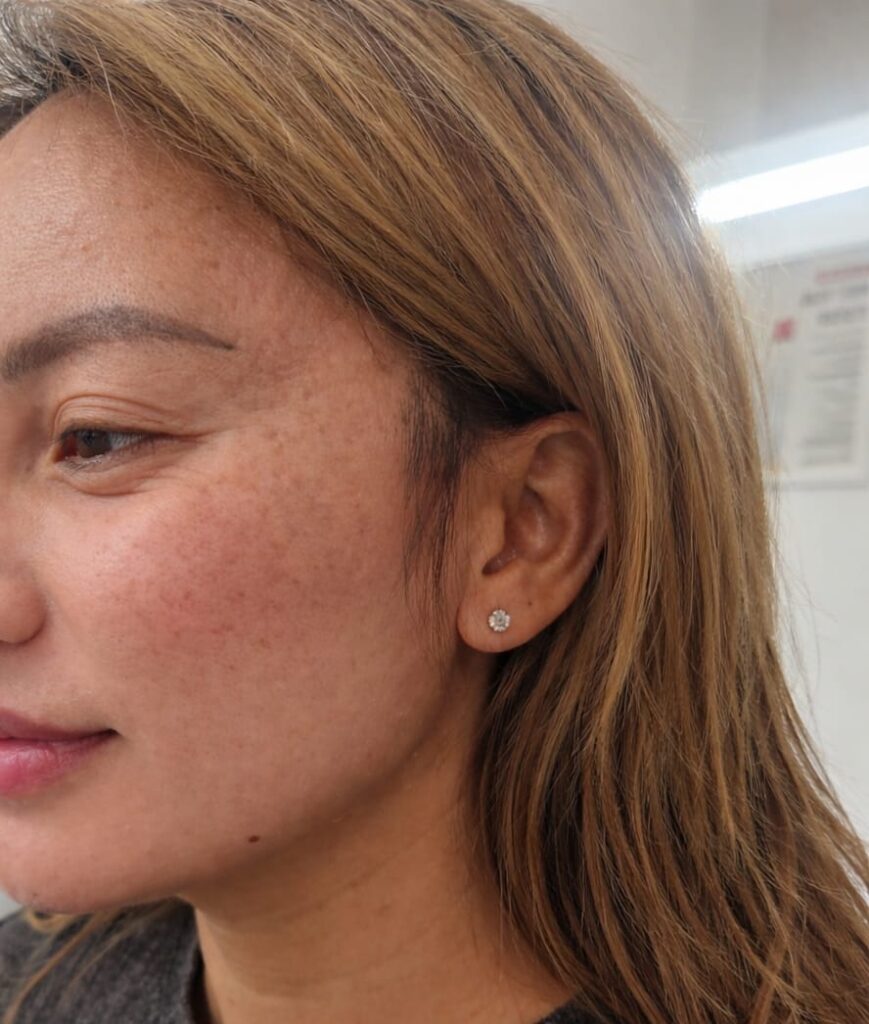
As we age, the buccal fat pads in the cheeks descend with gravity, creating that slight sagging along the edge of the jawline that we associate with jowling. This is driven by a combination of fat descent and reduced mandibular bone density — structural changes rather than purely surface ones.
The temptation is to fill directly along the base of the jowl to lift it. I’m very cautious about this approach because adding volume at that point can make the jaw look too heavy — and again, too masculine. What I find works better is an indirect technique: placing a bolus at the mandibular angle — the angle of the jaw just below the ear — and then continuing with filler into the chin, leaving a deliberate gap where the jowl sits. What that does is align either side of the jowl, creating a more even jawline overall. The jowl doesn’t disappear, but the visual impression of it is significantly reduced because the jaw either side of it now reads as more consistent and defined.
It’s about creating an illusion of a more even jawline rather than physically lifting tissue that filler can’t lift. When it’s done correctly, the result is a jawline that looks natural, feminine, and refreshed — not one that looks treated.
Does jawline filler work for a round face?
It can, depending on the specific anatomy. Adding definition along the mandible and sharpening the jaw angles can create the visual impression of a more structured, elongated lower face — which some clients with rounder features find significantly improves overall facial balance. The “chubby face” searches for jawline filler are very common, and in the right candidate the results can be striking.
That said, face shape alone isn’t a sufficient reason to recommend treatment. What matters is whether the jaw specifically is contributing to the concern, whether the anatomy supports the result the client is looking for, and whether filler is the right approach. Sometimes the more impactful change comes from a different area — cheek filler can improve lower-face balance significantly without touching the jawline directly.
How long does jawline filler last?
Jawline filler typically lasts between twelve and eighteen months. The jawline is a relatively low-movement area compared to the lips or perioral region, and product placed deeply against the bone tends to last well. Individual factors — metabolism, skin quality, lifestyle — influence exactly how long results are maintained. Results vary between individuals.
As with all hyaluronic acid filler, the product is fully dissolvable using hyaluronidase if needed. At Awlin Beauty I use only hyaluronic acid fillers — the reversibility is an important safety consideration, particularly in an area where placement matters as much as it does along the jaw.
Does jawline filler hurt?
Most clients find it very manageable. A topical anaesthetic is applied before treatment, and the filler contains lidocaine which provides additional comfort during injection. Placement along the jawline is generally well tolerated — most people describe a mild pressure sensation rather than sharp pain. Some tenderness, swelling, and bruising in the days following treatment is normal and usually resolves within a week.
What jawline filler can’t do
Jawline filler can’t change the position of the jaw bone, correct a significant skeletal deficiency, or replicate what a surgical procedure achieves. It also won’t resolve a double chin — submental fat is a separate issue that filler along the jaw doesn’t address. And as covered above, significant jowling driven by skin laxity and tissue descent is better addressed through a different conversation rather than jawline filler alone.
Overfilling is also a real risk in this area. A heavy or overdone jawline — where too much product has created a boxy or unnatural border — is difficult to correct and can take considerable time to resolve even with dissolving. Conservative placement, good technique, and building gradually over sessions is always the better approach.
Choosing a practitioner for jawline filler
The jawline sits close to important vascular and nerve structures. Since 2023, UK law requires dermal filler treatments to be performed or overseen by a registered healthcare professional. For an anatomically complex area like the jawline, that clinical background matters considerably — not just for the quality of the result but for safe management if a complication occurs.
At Awlin Beauty, Clare is NMC-registered with over 20 years of clinical experience, including specialist training in Oral and Maxillofacial surgery at the Eastman Dental Hospital — which gives her a particular depth of knowledge of lower-face anatomy. If you’d like to discuss whether jawline filler is right for you, you can book a consultation at Awlin Beauty here. Assessment always comes before any treatment recommendation.