Not sure whether your skin needs hydration, volume or support? i’ll explain what each treatment is, the differences between the two and how it can benefit you.

Lead Practitioner & Director, Awlin Beauty Medical Aesthetics, Maidstone
A lot of people come in knowing something has changed, but they can’t quite put their finger on it.
They might say their skin looks tired, their face looks flatter Or their under-eyes look dull. Makeup might be sitting differently. The cheeks might not look as lifted. Lines around the mouth may look stronger than they used to.
They usually don’t come in saying, “I need skin boosters,” or “I need dermal filler.”
They come in saying, “I don’t look as fresh as I used to.”
That gives us something to work with.
Because once you start looking at treatments online, it gets confusing very quickly.
Skin boosters are talked about for glow, hydration and tired-looking skin. Dermal fillers are talked about for lips, cheeks, folds, jawlines and facial balancing. Both are injectable treatments. Both can help someone look fresher when they’re used properly.
But they’re not the same thing.
At Awlin Beauty Medical Aesthetics in Maidstone, I usually explain it like this:
Skin boosters work more on the skin itself.
Dermal fillers work more on the shape and support underneath.
So if your skin looks dull, thin, dry or crepey, a skin booster may be worth discussing. If you think your cheeks have lost volume, your lips have lost shape, or your lower face looks heavier, dermal filler may be more relevant.
The mistake is choosing a treatment before anyone has properly assessed what’s actually going on. A treatment can sound perfect online and still be wrong for your face.
The easiest way to understand skin boosters vs dermal fillers is to ask one question:
Are we trying to improve the skin, or are we trying to support the structure?
Skin boosters are usually used for skin quality. They’re more about hydration, texture, glow, crepiness and tired-looking skin.
Dermal fillers are usually used for structure. They’re more about lips, cheeks, folds, chin, jawline, facial balance and volume loss.
Here’s a simple guide:
| Concern | More likely to be discussed |
| Dry or dehydrated-looking skin | Skin boosters |
| Dull skin or loss of glow | Skin boosters |
| Fine crepey texture | Skin boosters |
| Tired-looking under-eyes | Lumi Eyes or skin booster assessment |
| Loss of cheek volume | Dermal filler |
| Thinner lips or loss of lip definition | Lip filler |
| Deeper nasolabial folds | Filler assessment |
| Marionette lines or lower-face heaviness | Filler assessment |
| General tired or aged appearance | Needs assessment first |
The awkward bit is that clients often describe different problems using the same words.
“Tired” can mean dull skin. It can also mean under-eye shadows, flatter cheeks, deeper folds, or lower-face heaviness.
That’s why the treatment is not always obvious from the mirror.
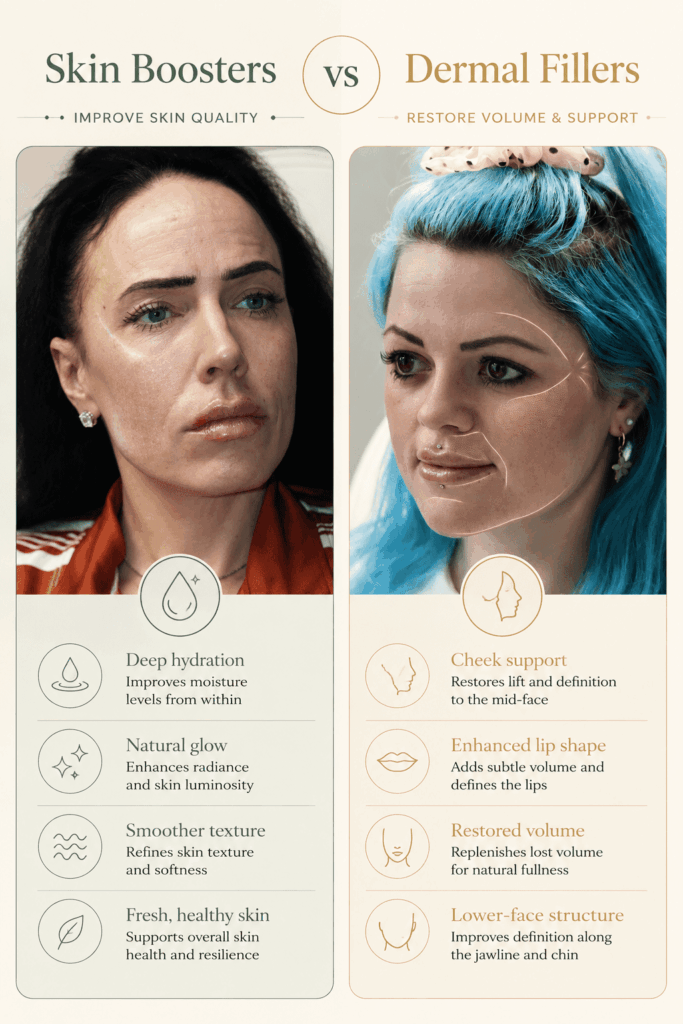
Skin boosters are injectable treatments used to improve how the skin looks and feels.
They’re not there to build cheekbones, reshape lips or create a sharper jawline.
They’re usually used when the main concern is skin quality.
Clients often ask about skin boosters in Maidstone when their skin feels dry, flat, tired or less fresh than it used to.
Skin boosters may be discussed for:
This is often the client who says:
“I don’t want to look different. I just want my skin to look better.”
That’s a very clear goal.
At Awlin Beauty, Jalupro skin booster in Maidstone may be suggested for clients wanting to support hydration, freshness and overall skin quality.
For the eye area, LINK: Lumi Eyes in Maidstone may be more relevant if the concern is tired-looking under-eyes, dullness or delicate under-eye skin.
A skin booster shouldn’t make you look like someone else. For the right client, that’s exactly the appeal.
Dermal fillers are injectable treatments used to support shape, volume and structure.
They’re often discussed when the concern is not just the surface of the skin, but the support underneath it.
That might mean lips that have lost shape, cheeks that look flatter, folds that look deeper, or a lower face that feels heavier.
Dermal fillers may be used to assess and treat concerns such as:
This is where dermal fillers vs skin boosters becomes more than just a comparison.
If someone has lost cheek volume, a skin booster won’t rebuild that support. It may help the skin look fresher, but it won’t put structure back.
If someone wants clearer lip shape, a skin booster won’t do the same job as lip filler in Maidstone.
If someone has deeper folds around the mouth, they may need an assessment for nasolabial fold filler or marionette lines filler, rather than assuming hydration alone will soften everything.
Dermal filler is not just about making areas bigger.
Used carefully, it can soften shadows, restore balance and support areas that have changed.
Used badly, it can make the face look heavy, puffy or overdone.
Filler needs judgement. Product alone is not enough.
Skin boosters may make more sense when your face still feels like your face, but the skin itself looks tired.
Your cheeks may not need volume. Your lips may not need more shape. The lower face may not need structural support. But the skin looks dull, dry or crepey.
That’s usually a skin quality conversation.
You might notice:
This is where filler can be the wrong answer.
If the face doesn’t need volume, adding volume won’t magically make the skin look better. It may just add fullness where fullness was not needed.
A skin booster won’t lift a heavy lower face. It won’t give you cheekbones. It won’t change your lip shape.
But if the issue is dullness, dehydration or fine crepiness, it may be much closer to what you were hoping for.
The result is usually subtle. Less “what have you had done?” and more “your skin looks well.”
Dermal fillers may make more sense when the concern is shape, support or volume loss.
This could be the client who says:
“My cheeks look flatter.”
“My lips have lost shape.”
“My folds look deeper.”
“My lower face looks heavier.”
“My face just looks less lifted than it used to.”
In those cases, the skin may not be the main issue. The support underneath may have changed.
For example, deeper nose-to-mouth folds can sometimes be linked to changes in mid-face support. Filling the fold directly is not always the whole answer. In some clients, cheek filler in Maidstone may be discussed as part of the assessment.
That doesn’t mean everyone with nasolabial folds needs cheek filler.
It means the reason behind the fold needs to be understood before anyone starts treating it.
Dermal filler may be more relevant if:
Good filler should sit quietly in the face. It shouldn’t announce itself.
When filler looks obvious, it’s often because too much has been used, the wrong area has been treated, or the face has been treated in pieces instead of as a whole.
“Tired” is one of the most common words people use in my clinic.
It’s also one of the least specific.
Tired can mean dull skin. It can mean crepey under-eyes. It can mean hollowing.
It can mean shadows around the mouth. It can mean flatter cheeks or a heavier lower face.
So when someone asks whether skin boosters vs fillers are better for tired-looking skin, the honest answer is: we need to look at why you look tired.
If the tired look is mainly dullness, dehydration or fine texture, skin boosters may be the better route.
If it’s coming from volume loss, shadows or changes in facial support, dermal fillers may be more suitable.
Under-eyes are a good example. Some under-eye concerns are about skin quality. Some are about hollowness. Some are pigmentation. Some are puffiness. Quite a few are a mixture.
If the issue is delicate under-eye skin or tired-looking under-eyes, Lumi Eyes may be discussed.
If the issue is structure or volume loss, that needs a different assessment.
The word “tired” is only the starting point. The cause is what guides the plan.

Fine lines are not all the same.
Some are linked to dryness, dehydration and skin texture. Others are linked to movement, volume loss, sun exposure, ageing or deeper creasing.
Skin boosters may be useful where fine lines are more connected to skin quality.
Dermal fillers may be considered where lines or folds are linked to support loss, volume loss or structure.
This is especially true around the mouth.
Fine vertical lines around the lips are not the same as deeper nasolabial folds or marionette lines. They sit in different areas and often need different approaches.
For some clients, perioral lines filler may be discussed if the concern is fine lines around the mouth.
For others, improving skin quality may be the better first step.
A mirror can show you the line. It cannot always show you the reason behind it.
Yes, skin boosters and dermal fillers can be part of the same treatment plan.
That doesn’t mean everything should be done at once.
Some clients need skin quality support first. Some need structure first. Some need a staged approach because there’s more than one thing going on.
A client with dull, dehydrated skin but good facial structure may only need skin boosters.
A client with flatter cheeks and deeper folds may be better suited to dermal filler.
A client with both skin quality changes and volume loss may need a plan that deals with both, but in the right order.
This is where a personalised treatment plan can be useful.
It stops treatment being chosen from one isolated complaint. The face works together, so the plan should too.
The hard truth here is that the wrong treatment can still be done well and leave you disappointed.
If you choose a skin booster when the real issue is volume loss, your skin may look a little fresher, but the shape concern will still be there.
If you choose filler when the real issue is poor skin quality, the face may have more volume, but the skin can still look dull, dry or crepey.
Filler won’t fix dry skin.
Skin boosters won’t build cheek structure.
Lumi Eyes won’t correct every type of under-eye concern.
Lip filler won’t solve general facial ageing.
A treatment can be good and still be wrong for you.
That’s why I don’t like people choosing treatments purely because they have seen a nice before-and-after online. The result might be lovely on that person because it matched their concern. Your face might need something else.
People often ask which lasts longer, but it’s not always the best first question.
Skin boosters and dermal fillers are trying to do different jobs.
Dermal filler is usually chosen for shape, volume and support. Skin boosters are chosen for hydration, freshness and texture.
If you want more defined lips, a skin booster won’t give you that result.
If your skin looks dull and crepey, cheek filler may not be the answer.
Longevity only matters after suitability.
There’s no point choosing the longer-lasting option if it doesn’t treat the concern you actually have.
The better question is:
“What are we trying to improve?”
Once that’s clear, we can talk properly about treatment choice, expected results and maintenance.
People often assume skin boosters are more natural because they don’t usually change facial shape in the same way.
I understand why people think that, but it’s not quite that simple.
A skin booster can look natural when it’s suitable.
Dermal filler can also look natural when it’s planned properly and used carefully.
The problem is not filler itself, but poor judgement, over-treatment, chasing trends, or putting filler where it’s not needed.
A small amount of well-placed filler can look far more natural than repeated treatments that don’t match the concern.
Natural-looking aesthetics comes from choosing the right treatment for the right person.
Not the treatment with the fancy-sounding name.
Ageing doesn’t show up in one neat way.
Some people notice skin changes first: dryness, dullness, fine lines, crepiness, loss of glow.
Others notice shape changes: flatter cheeks, deeper folds, thinner lips, lower-face heaviness, less definition around the jawline.
Most people have a bit of both.
So there’s no honest answer that says skin boosters are better than dermal fillers, or dermal fillers are better than skin boosters.
It depends on how ageing is showing in your face.
If the concern is mainly skin quality, skin boosters may be a sensible place to start.
If the concern is mainly facial volume loss or structure, dermal fillers may make more sense.
If both are happening, a staged plan may be the best option.
The aim of medical aesthetics isn’t removing every sign of ageing until the face looks different.
The aim is to make considered changes that still feel like you.
Remember, you don’t need to arrive knowing whether you need skin boosters or dermal fillers.
Most people don’t.
You only need to explain what is bothering you in normal language.
“My skin looks tired.”
“My cheeks look flatter.”
“My under-eyes look dull.”
“My folds are deeper.”
“My face just doesn’t look as fresh.”
That’s enough for a nurse led aesthetics clinic to start with.
From there, I can look at whether the concern is more about skin quality, volume loss, structure, movement, or a mixture.
At Awlin Beauty, consultation is not about pushing the treatment that sounds best on paper. It’s about working out what is suitable, what is realistic, and what should be left alone.
If filler is not right, I will say so.
If a skin booster won’t do what you are hoping for, I will explain why.
You shouldn’t have to guess your way into treatment.
So if you’re trying to decide between skin boosters vs dermal fillers in Maidstone, the best starting point is a proper consultation.
You may already have a treatment in mind or you may simply know that your skin looks tired, your face looks less fresh, or your features don’t feel quite as balanced as they used to.
Both are fine.
At Awlin Beauty Medical Aesthetics in Maidstone, your consultation looks at your skin quality, facial structure, natural features, goals and suitability before any recommendation is made.
You may be better suited to skin boosters or you may be better suited to dermal fillers.
A staged plan may be syggested or you may be advised that treatment is not the right step yet.
That conversation is much better than guessing from a treatment list.
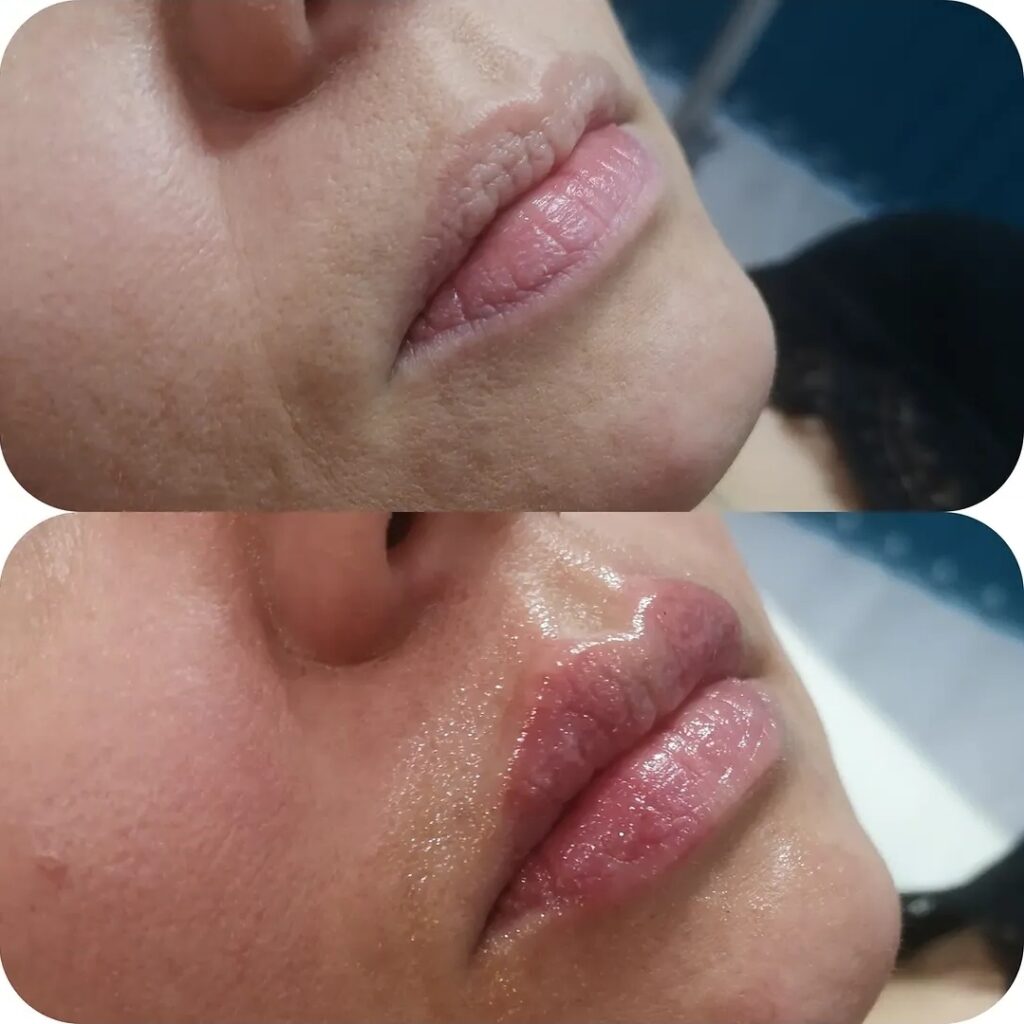
Skin boosters are mainly used to improve skin quality, hydration, freshness and texture. Dermal fillers are mainly used to support shape, volume and structure, such as lips, cheeks, folds or facial balancing.
No. They’re both injectable treatments, but they’re used for different reasons. Skin boosters focus more on skin quality. Dermal fillers are used more for volume, definition and support.
Not automatically. Skin boosters may be better if your concern is dull, dry or crepey skin. Dermal fillers may be better if the concern is volume loss, deeper folds, lip shape or facial structure.
Usually no. Skin boosters can improve skin hydration and quality, but they don’t create the same shape, lift or volume as dermal fillers.
Dermal fillers can improve the appearance of some areas by adding support or volume, but they’re not the same as skin boosters. If the concern is mainly dullness, dehydration or crepey texture, a skin booster may be more relevant.
Yes, some clients may benefit from both, usually as part of a planned approach. It depends on your skin, facial structure, goals and suitability.
It depends why the skin looks tired. If the issue is dullness, dehydration or crepey texture, skin boosters may help. If the tired look comes from volume loss or facial shadows, dermal fillers may be more suitable.
Yes. A consultation helps identify whether your concern is skin quality, volume loss, facial structure or a combination. This helps avoid choosing a treatment that doesn’t match the actual issue.
Treatment
For clients wanting to support skin hydration, freshness and overall skin quality.
Treatment
For clients concerned about tired-looking under-eyes or delicate skin quality.
Treatment
For clients concerned about flatter cheeks, mid-face support or facial balance.
Treatment
For clients considering natural-looking lip shape, definition or volume.
Treatment
For clients concerned about nose-to-mouth folds or mid-face support changes.
Book a consultation with Clare to discuss your aesthetic goals and create a personalised treatment plan. Every consultation includes a full facial assessment to ensure safe, balanced and natural-looking results.