
How long does lip filler last? It’s one of the most searched questions about the treatment, and the answer most blogs give — six to twelve months — is tHow long does lip filler last? It’s one of the most searched questions about the treatment, and the answer most blogs give — six to twelve months — is technically accurate but doesn’t tell the whole story. What most people actually want to know is what the first two weeks look like, whether the result they see immediately is the one they’ll keep, and what happens to their lips when the filler eventually wears off. This post covers all of it honestly.
What is lip filler and why doesn’t it last forever?
Lip filler is typically made from hyaluronic acid — a substance naturally produced by the body — injected into the lips to add volume, shape, and definition. Because hyaluronic acid occurs naturally, the body gradually metabolises it over time, breaking it down through normal enzymatic processes. This is what makes the treatment temporary — and also what makes it safe and reversible.
The rate at which this happens varies between individuals, which is why the duration range is as wide as it is. Two people can have the same product, the same volume, and the same technique and still find their results last meaningfully different lengths of time.
How long does lip filler last — the honest answer
Most blogs answer this with one word: metabolism. That isn’t wrong, but it’s an oversimplification of a genuinely complex subject. Metabolism refers to all the chemical processes happening continuously in the body. Your basal metabolic rate — your BMR — is a big part of it: if you have a high BMR, your body processes the enzymes that break down hyaluronic acid faster. People with higher muscle mass who are leaner tend to have a higher basal metabolic rate, which means they often metabolise lip filler more quickly. The same applies to people with intensive cardiovascular routines — high-intensity exercise tends to break filler down faster.
But metabolism is only half the story. The lips are highly mobile and extremely vascular — we use them constantly to speak, eat, and express ourselves, and all that movement actively assists in breaking the filler down. This is why the lips are one of the shorter-duration areas. Static areas of the face like the cheeks and chin generally hold filler far longer — often twelve to eighteen months, sometimes up to two years — precisely because they don’t move as much.
Generally, I’d say to expect lip filler to last approximately six months, with many clients getting longer. The product itself matters too: although these are all hyaluronic acid based, some contain other components that produce a slightly more inflammatory response, causing the area to swell and look more plump initially. The right expectation depends on your individual metabolism, your lifestyle, and the specific product used.
What the first two weeks actually look like
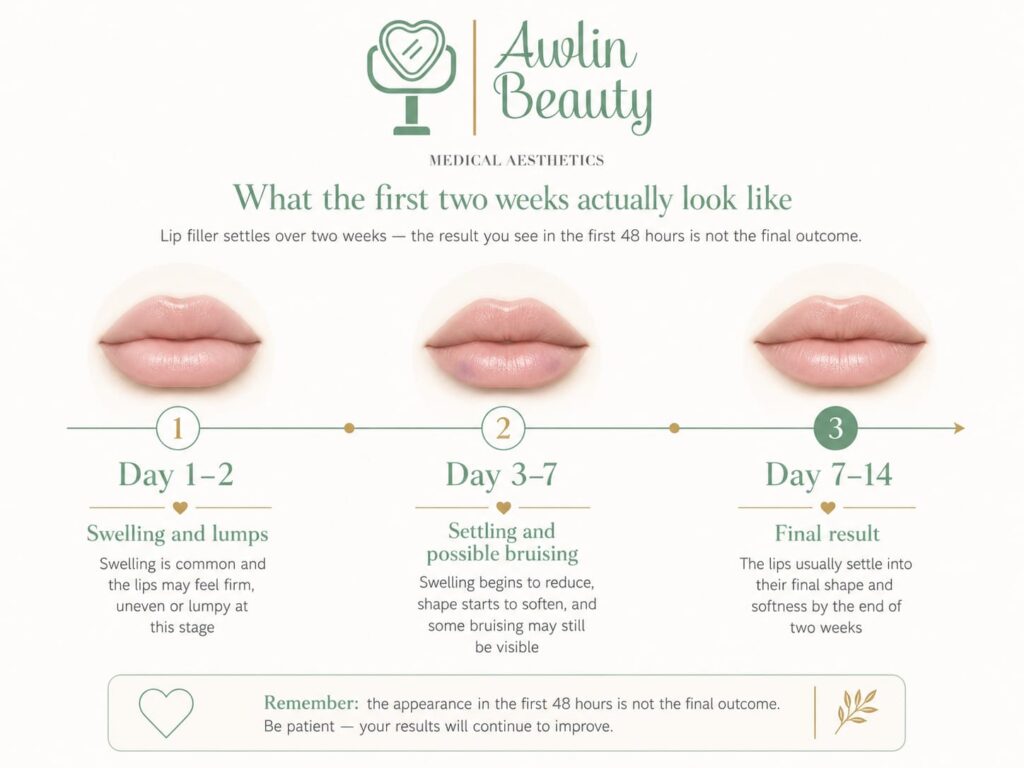
A lot of people become anxious in the first two weeks after their first treatment, so it helps to know exactly what to expect. The reason we say to wait two weeks before judging the result is simple — that’s when you see the final outcome. Everything before that is the lips settling.
Days one to two. The lips will feel swollen and lumpy. This is normal. Personally, I use very small bolus injections — a bolus simply means a single measured amount of filler deposited in one spot. Rather than placing large amounts in few spots, I use more injection points with less filler in each, spreading the product out more evenly. I’ve seen other practitioners use large boluses, which can lead to complications: excessive swelling, and compression that can contribute to vascular occlusion. A 2025 systematic review of filler-related vascular occlusion identified the lips as a high-risk area and found safer outcomes were associated with low-volume micro-bolus delivery. It’s always better to do more injections placing less filler.
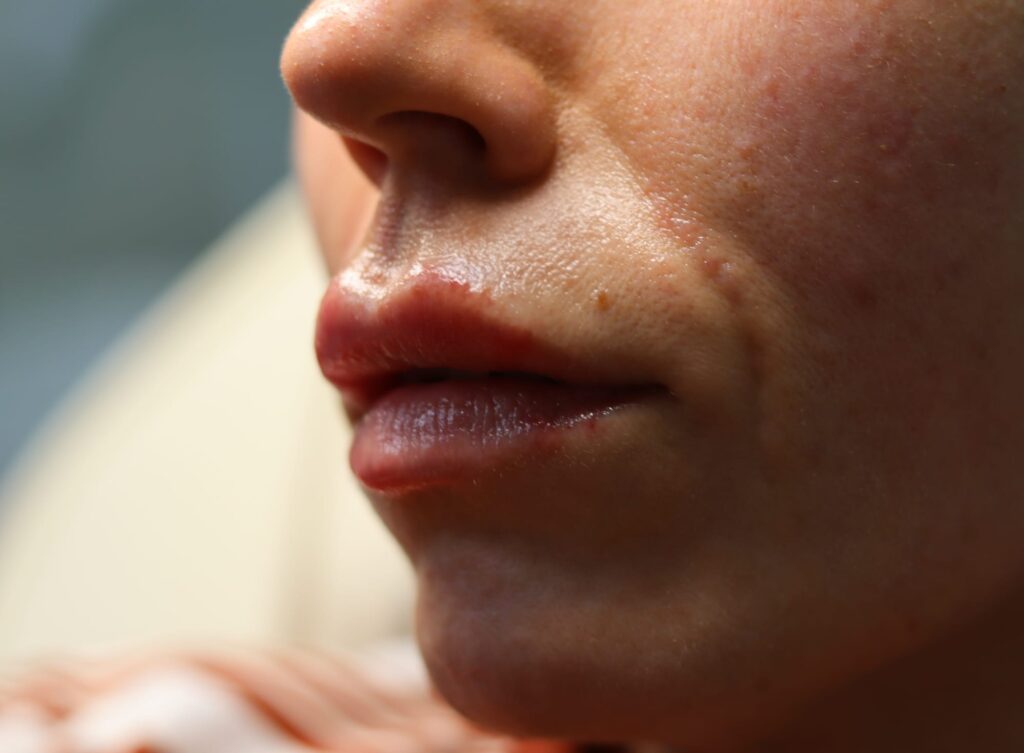
Days three to seven. The lips may appear uneven as the filler settles into place — some areas may look more swollen than others. You may see bruising start to appear; this is simply blood that has leaked from the small puncture points and become trapped under the skin. Some redness can occur too. All of this is normal, provided the area isn’t hot to touch, overly swollen, excessively bruised, or unusually pale (blanched) — those would be reasons to make contact.
Days seven to fourteen. This is the settling-down period. The lips may still look slightly swollen, but you’ll increasingly see the finished result. By two weeks, the filler has integrated and the lips have settled into their final shape — this is the point to assess the outcome and raise any concerns.
What affects how long lip filler lasts?
Metabolism. The single biggest variable. Some people break down hyaluronic acid significantly faster than others — this isn’t something that can be predicted before a first treatment, but it becomes clearer after one. High-intensity exercise and an active lifestyle can also accelerate how quickly the product is metabolised.
Treatment history. First-time clients almost always find their filler lasts toward the shorter end of the range. With consistent treatment over time, the tissue adapts and tends to hold the product longer. This is one of the reasons I encourage clients not to judge the treatment purely on their first experience.
Volume used. More product generally lasts longer than less, up to a point. A very conservative 0.5ml treatment will typically wear off sooner than 1ml — there’s simply less product for the body to metabolise before the result is noticeably reduced. If you’re weighing up amounts, our 0.5ml vs 1ml guide goes into this in more detail.
The product used. Different hyaluronic acid products have different cross-linking densities — essentially how tightly the molecules are bonded together. More densely cross-linked products last longer but also feel firmer. The right product for each client depends on what they’re trying to achieve, their lip anatomy, and their personal preference for how the lips feel.
Sun exposure, smoking, and lifestyle. UV exposure and smoking both accelerate collagen breakdown and can affect how quickly filler degrades. Staying well hydrated supports skin quality generally and may have a minor positive effect on longevity, though this isn’t well evidenced in isolation.
Do lips go saggy or stretch when lip filler wears off?
This is probably the most common fear clients arrive with — that once the hyaluronic acid is reabsorbed, they’ll be left with saggy or loose skin. I want to be clear: this is not true, and there’s no research to support it. Research analysing lip structure after hyaluronic acid augmentation found that the underlying lip pattern remained unchanged following treatment — the filler doesn’t damage or stretch the skin. What it does is offer a temporary solution for creating more volume or reshaping the lip you already have.
So what actually happens as it wears off? The volume gradually decreases — never overnight, always slowly. You may start to see more lines or definition return to the area as the volume reduces. The body’s natural enzymes break down the hyaluronic acid; its matrix loses the capacity to bind water, and the localised volume gradually reduces. Because of its low molecular weight, the broken-down filler is then cleared through the vascular and lymphatic networks — reabsorbed and removed by the body the same way it clears other waste products.
There has been some recent scaremongering about filler migrating into the face and other areas. There is no research to support this at present — as far as the current evidence shows, it simply reabsorbs, which is reflected in the gradual loss of lip volume over the six to twelve month period. One small psychological note: some people experience a kind of “lip filler blindness” — they forget what their original lips looked like, much like going nose-blind to a familiar smell. That’s a perception effect, not the filler doing anything to the lips.
Do lips go back to normal after filler?
Yes — when hyaluronic acid filler wears off naturally, the lips return to their pre-treatment appearance. This happens gradually over weeks rather than suddenly. Many clients find they don’t notice the filler wearing off until the lips feel noticeably different to how they did mid-treatment, at which point they’ll come in for a top-up.
One thing worth noting: the natural ageing process continues regardless of treatment, so lips at two years post-treatment won’t look exactly as they did before the very first appointment — but that’s ageing, not filler. The filler itself doesn’t cause or accelerate that.
How often should you get lip filler?
For most clients, a top-up every six to nine months is a reasonable maintenance schedule. Some clients come every six months consistently; others find they’re happy to leave it closer to twelve months once they’ve built up some treatment history. I’d rather a client comes back when they feel they need it than on a rigid schedule that doesn’t match how their lips are actually looking.
What I’d caution against is having treatment before the previous filler has fully metabolised and integrated. Building up layers of product without adequate time between sessions can lead to an overfilled look that becomes progressively harder to manage. If you’re unsure whether you need a top-up or a full treatment, booking a lip filler treatment consultation is the right starting point.
Can lip filler be dissolved?
Yes. Hyaluronic acid filler can be dissolved at any point using an enzyme called hyaluronidase. This is one of the most important safety features of hyaluronic acid filler — it means the treatment is fully reversible if you’re unhappy with the result, if migration has occurred, or if a complication needs to be addressed. At Awlin Beauty we only use hyaluronic acid filler in the lips for exactly this reason. You can find more information on our lip filler dissolving page.
Choosing a practitioner for lip filler
Since 2023, UK law requires dermal filler treatments to be performed or overseen by a registered healthcare professional. Lip filler is one of the most commonly performed aesthetic treatments — and one of the most commonly performed incorrectly. The lips are vascular, the margin between a natural result and an overdone one is narrow, and knowing what appropriate volume looks like over time is as important as the injection itself.
At Awlin Beauty, Clare is NMC-registered with over 20 years of clinical experience, including specialist training in Oral and Maxillofacial surgery at the Eastman Dental Hospital.
Get in touch to discuss lip filler or book a lip filler consultation today.