
Jalupro is one of the most clinically interesting skin booster treatments available — and one of the most misunderstood. It’s frequently described simply as “a skin booster with amino acids and hyaluronic acid,” which is accurate but doesn’t tell you much about what it actually does to the skin, why it works differently from other injectable treatments, or which formulation is right for your specific concern. This post covers all of that.
At Awlin Beauty, Jalupro is one of the skin treatments I recommend most consistently — because when it’s matched to the right client and the right concern, the results are genuinely impressive. But it isn’t the right treatment for everyone, and being clear about that matters.
What is Jalupro?
Jalupro is an injectable skin booster — technically classified as a dermal biorevitaliser — that works by delivering a combination of amino acids and hyaluronic acid directly into the dermis. Unlike dermal fillers, it doesn’t add volume or reshape the face. What it does is improve the quality of the skin itself — hydration, firmness, texture, and luminosity — by prompting the skin’s own repair mechanisms to work more actively.
The key ingredient distinction that sets Jalupro apart from many other skin boosters is its amino acid complex — glycine, L-proline, L-leucine, and L-lysine. These are the building blocks of collagen and elastin, delivered directly to the fibroblasts (the cells in the dermis responsible for producing these structural proteins). Clinical research supports the role of amino acids in stimulating fibroblast activity and collagen synthesis — the result isn’t an immediate plumping effect but a gradual improvement in skin quality as the skin’s own production increases over several weeks.

Jalupro is not a filler
Its important to make this distinction because clients sometimes arrive expecting Jalupro to do what dermal filler does: add volume, soften a deep fold, or reshape an area. That’s not the job of a skin booster. The hyaluronic acid in Jalupro is a much lower concentration than in filler used for adding structure, and it’s not formulated to create lift or projection. its formulated to give deep hydration, improved skin quality, and a gradual increase in the skin’s own collagen and elastin.
If your primary concern is volume loss — hollow cheeks, deep nasolabial folds, a less defined jawline — Jalupro isn’t the starting point. Jalupro is the correct tool for improvements to the quality of your skin by removing dullness, dehydration, fine texture or loss of firmness. Many clients benefit from a combination of both, and they work well together as part of a broader treatment plan.
Jalupro Classic — what it is and who it suits
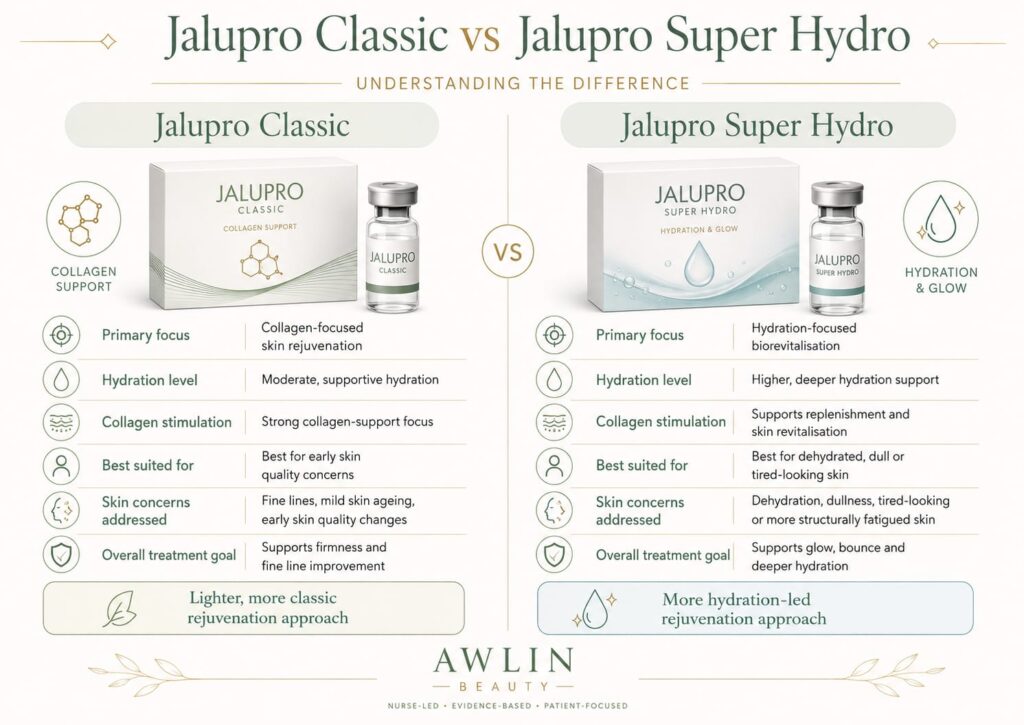
Jalupro Classic has a lower hyaluronic acid content and is formulated for delicate skin areas and younger clients. It works exceptionally well under the eyes, on acne scarring, pitting, and the very first signs of ageing — the fine lines that start appearing in the late twenties and early thirties. For someone in that age group who wants to start taking care of their skin quality proactively, Classic is usually where I’d begin.
A minimum of three sessions is recommended, with some clients benefiting from up to six, spaced at least two weeks apart. The amino acids work cumulatively — each session builds on the last — so committing to a course rather than a single treatment gives a meaningfully stronger result.
Jalupro Super Hydro — what makes it different
Jalupro Super Hydro is a different product with a different purpose. It has one of the highest hyaluronic acid concentrations of any skin booster on the market — higher than Profhilo, which gets far more attention but is less potent in this regard. Profhilo has significant brand awareness; Super Hydro is genuinely underrated, and I’d highly recommend it, it’s my favourite skin booster to use and the results are excellent.
The idea behind Super Hydro is deep hydration combined with a subtle lift. It’s placed at specific points on the face where the facial ligaments sit — around the jawline and cheeks — and the effect is a gentle structural lift in those areas alongside the skin quality improvement. It’s very high in amino acids and peptides, making it a regenerative product particularly well suited to mature skin. You don’t need as many sessions of Super Hydro to see results, and the hydration and skin lifting benefits are quite noticeable.
If someone in their twenties came to me wanting a skin booster, I’d typically recommend Classic — particularly for acne scarring or early fine lines. But for mature skin wanting overall rehydration, lifting, and skin quality restoration, Super Hydro is my first choice. That said, the right product is always tailored to the individual face and concern — it’s exactly what a consultation is for.
Who is Jalupro for?
Jalupro suits a wide range of clients but it’s particularly well matched to a few specific presentations. Clients in their mid-thirties to fifties noticing a general decline in skin quality — skin that looks tired, flat, dehydrated, or has lost its bounce — often see the most meaningful improvement. It’s also a good option for clients who want to complement structural filler treatment with skin quality improvement, or who want to start preventive treatment before volume loss becomes the primary concern.
It works well across the face, neck, and décolletage — areas where skin quality decline is often noticeable but where filler isn’t the appropriate tool. The neck and décolletage in particular are areas where clients struggle to find effective non-surgical options, and Jalupro’s skin quality improvements in these zones can be quite significant.
Jalupro is not appropriate during pregnancy or breastfeeding, and may not be suitable for clients with certain autoimmune conditions or allergies. Suitability is always assessed at consultation.
What Jalupro feels like and what to expect afterwards
Both products involve very superficial injections — they don’t go deep into the skin layers. You can feel a little stinging during treatment, and immediately afterwards the skin may look and feel slightly lumpy or bumpy at the injection points. This is entirely normal. We always say to allow up to two weeks for this to settle, but in practice most people find those bumps have gone within a few days.
Some clients notice a slight tightening sensation after treatment — a feeling a little like mild sunburn, a gentle pulling or tightness in the skin. This is also normal and part of the skin’s response to the treatment. It passes.
Bruising is very rare and tends to be minimal when it does occur — needle-sized entry point bruising at most. A few things can make bruising more likely: being dehydrated, being at a particular point in your menstrual cycle, or having had alcohol recently. I’d recommend avoiding alcohol before treatment for this reason, as it affects coagulation.
For aftercare, you can continue your normal skincare routine but I’d suggest avoiding anything harsh — particularly retinol — for about a week. A gentle cleanser and moisturiser is fine. Your skin will be doing its work in the background; there’s no need to interrupt that with active ingredients while it settles.
How many sessions are needed and how long does it last?
For Jalupro Classic, a minimum of three sessions is recommended, with some clients having up to six, spaced at least two weeks apart. For Jalupro Super Hydro, fewer sessions are typically needed to achieve a good result. Results from a completed course generally last between three and six months, with maintenance sessions every few months sustaining the improvement over time.
Jalupro isn’t a one-off treatment. The clients who get the most from it are those who approach it as an ongoing part of their skin health routine rather than a single course. Results vary between individuals depending on age, skin condition, lifestyle, and sun exposure history.
Jalupro vs other skin boosters
The skin booster category has grown considerably in the last few years, so it’s worth understanding where Jalupro sits relative to other treatments. Profhilo — currently one of the most well-known skin boosters — uses a high-concentration hyaluronic acid formulation and works primarily through bioremodelling of the skin’s structural matrix. Jalupro Super Hydro actually has a higher hyaluronic acid content than Profhilo, and its additional amino acid and peptide complex makes it particularly strong for collagen stimulation and regeneration. It simply has less brand awareness — which in my view makes it one of the most underrated products in the category.
Lumi Eyes, which we also offer at Awlin Beauty, is a polynucleotide-based booster specifically formulated for the under-eye area — a different mechanism and a different use case from Jalupro. The two are complementary rather than interchangeable, and some clients benefit from both at different points in a treatment plan.
Choosing a practitioner for Jalupro
Since 2023, UK law requires injectable aesthetic treatments to be performed or overseen by a registered healthcare professional. At Awlin Beauty, Clare is NMC-registered with over 20 years of clinical experience. Every Jalupro treatment starts with an assessment of your skin condition, your concerns, and your treatment history — the right formulation and the right approach depend on what’s actually going on with your skin, not a generic protocol. If you’d like to discuss whether Jalupro is right for you, you can book a consultation at Awlin Beauty here.