

Chin filler is one of those treatments people research quietly. They’re not always sure exactly what it does, whether it’s for them, or whether they have the “right” kind of chin to benefit from it. I see a lot of consultations where chin filler wasn’t what the client came in for — they came in about their jawline, or marionette lines, or a general feeling that the lower face had changed. The chin turns out to be part of that picture.
This guide explains what chin filler actually does, the two quite different groups of people it tends to suit, what 1ml typically achieves, and when I’d advise someone to think carefully before going ahead.
What is chin filler?
Chin filler is a dermal filler treatment — typically hyaluronic acid, a substance the body produces naturally — injected into the chin to change its shape, volume, or projection. The product is placed precisely beneath the skin, usually in small amounts, to achieve a specific structural or cosmetic outcome.
Unlike lip or cheek filler, chin placement requires a solid understanding of lower-face anatomy. There are important blood vessels and nerves in this area, and the technique — depth, angle, and volume — matters significantly. It’s not a treatment to have done lightly or by someone without relevant clinical experience.
What does chin filler actually do?
The honest answer is: it depends entirely on why you’re having it. Chin filler can do several different things — but what it does for you depends on what your chin needs. I tend to think about chin filler clients in two distinct groups.
Two types of chin filler candidate
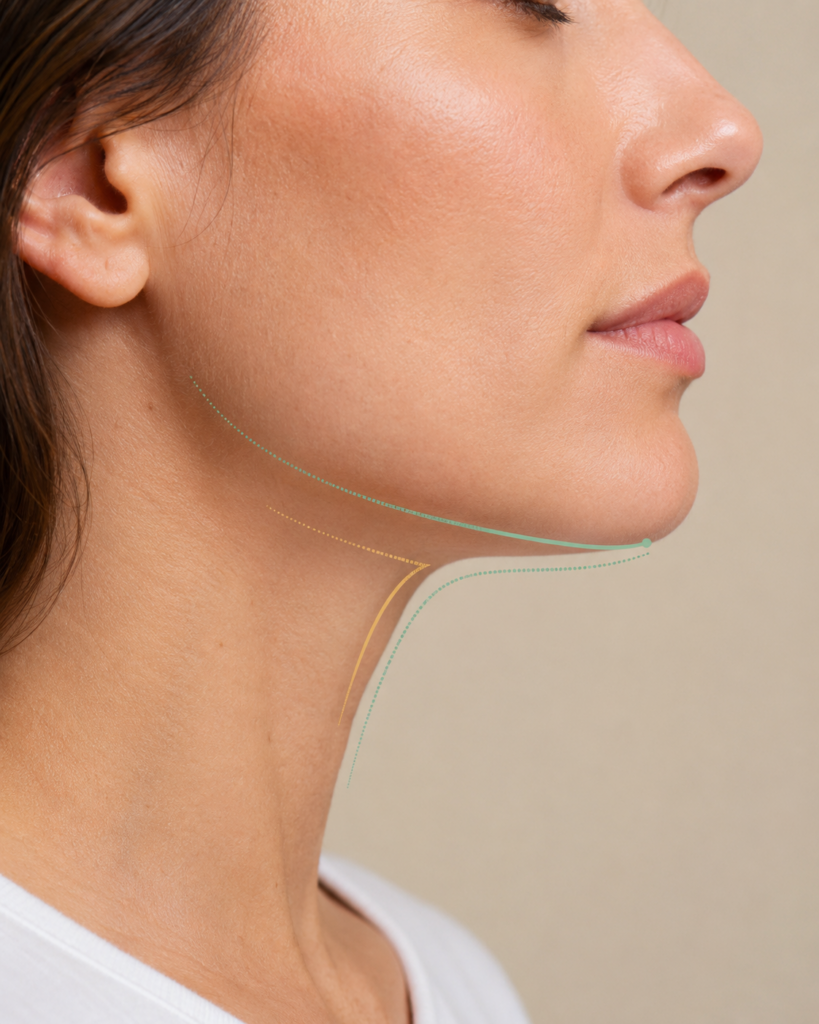
Group one: structural. This is someone with an anatomically small or recessed chin — they’ve likely always had a less defined profile, a shorter-looking lower face, or a chin that sits behind the lip line when viewed from the side. Filler here adds projection and forward definition. It can genuinely change the side profile, improve the balance between the nose and chin, and create a cleaner jaw-to-neck transition. In my experience, clients in this group are often younger, and frequently come in after noticing their profile in photos or video calls.
Group two: age-related volume loss. This is the group most blogs overlook entirely. As we age, the soft tissue of the chin pad thins and descends. The chin crease — the horizontal line between the lower lip and chin — deepens. The chin itself can start to look smaller than it used to, even if it was always well-defined. This is a different problem to a structurally small chin, and filler addresses it differently: restoring the lost volume, softening the crease, and lifting the appearance of the lower face rather than projecting the chin forward. Many of my clients in this group don’t come in asking specifically about their chin — they come in about their marionette lines or jowls, and we identify the chin as part of the picture during assessment.
Understanding which group you fall into — or whether you’re a combination of both — is exactly what a consultation is for. The placement, depth, and volume used are different depending on the underlying cause.
The chin crease most blogs don’t mention
One of the most common things I treat that rarely gets discussed is the chin crease specifically — the horizontal fold that forms just below the lower lip and above the chin. In some clients it’s a feature of their anatomy. In others, it develops or deepens with age as the chin pad loses support.
A small, precise amount of filler placed in the right depth can soften this significantly. It’s not about making the chin bigger — it’s about restoring the smooth, continuous curve from the lower lip to the chin that tends to disappear as volume decreases. When this crease deepens, it can create a shadow effect that ages the lower face considerably. Addressing it directly often gives a result that looks more refreshed than “treated.”
Here’s a real example of how I handle this scenario:
Mrs N (name protected for confidentiality) came to me feeling very concerned about her jowls. Since turning 45 she had noticed a definite sag in this area, and she suggested that we place filler along the entire jawline to correct this. I knew this wouldn’t resolve the issue she had and I advised her that placement there may well cause additional heaviness. I informed her that the correct filler for her needs and age needed to be used to resolve her concerns.
We placed a bolus in each mandibular angle to help support the jaw, we also added some to her marionette lines to soften her look and some to the chin and a little along the jawline. This careful placement balanced her profile and although it did not entirely eradicate the jowls, it gave them a sharper angle and support.
I believe it is best to manage expectations, rather than radically change a face and give a treatment that looks incredibly fake.
What does 1ml of chin filler typically achieve?
Most chin treatments use between 0.5ml and 2ml depending on what’s being addressed. For a first treatment, 1ml is a sensible starting point in many cases — it gives meaningful structural or volumetric change without overcorrecting, and allows us to assess how the face responds before adding more at a review.
With 1ml you can typically expect a noticeable improvement in chin projection or crease depth — not a dramatic transformation, but a genuine change to lower-face balance that most clients describe as looking “more like themselves.” Results are usually visible immediately, though the final outcome settles over two weeks as any mild swelling resolves. Results vary between individuals.
How chin filler supports jawline and lower-face balance
The chin doesn’t exist in isolation. Lower-face treatments tend to work best when the full picture is considered: the chin, jaw, and the mid-face above it all influence how each other looks. A chin that’s underprojected or volume-depleted can make the jawline appear heavier, jowls look more pronounced, and the neck-to-jaw transition less defined — even when those areas haven’t significantly changed.
This is why, at Awlin Beauty, I rarely assess the chin in isolation. Where chin filler is indicated, I’ll often discuss jawline filler at the same time — not because both are always needed, but because understanding how they interact gives you a clearer picture of what’s achievable and the best route to get there.
Is chin filler right for a round face?
This comes up often, and the short answer is: it can be, but it depends on the specific structure of your face rather than face shape alone. Adding subtle forward projection and definition to the chin can create the optical impression of a slightly longer, more balanced lower face — which some people with rounder features find helps the face look more defined overall.
That said, I wouldn’t recommend chin filler to anyone purely on the basis of face shape. What matters is whether your chin specifically is contributing to the concern you have about your face, and whether filler is the appropriate way to address it. Sometimes the answer is yes. Sometimes the bigger impact comes from a different area.
What chin filler can’t do
It’s important to be straightforward about this. Chin filler works within the limits of what soft-tissue augmentation can achieve. It cannot change the position of the jaw bone, correct a significant skeletal deficiency, or provide the kind of change that only surgery can deliver. In cases where the chin is very retruded relative to the rest of the face, a consultation with a maxillofacial surgeon may be more appropriate than filler.
It also won’t resolve a double chin. The submental fat and skin laxity that create a double chin are separate issues — filler in the chin itself won’t reduce them, and in some cases could make the area appear fuller if placed incorrectly. If that’s the primary concern, it’s a different conversation.
How long does chin filler last?
In most cases, hyaluronic acid chin filler lasts between nine and eighteen months. The range is wide because several factors influence how quickly the body metabolises the product — your metabolism, how active the muscles in the area are, and how much product was placed. The chin is a relatively low-movement area compared to the lips, which generally supports longevity.
Hyaluronic acid filler is also dissolvable if needed. This is an important safety consideration — it means that if you’re unhappy with the result or experience a complication, the product can be removed using a dissolving enzyme. This is one of the reasons I only use hyaluronic acid fillers in my practice.
UK regulations and choosing a practitioner
Since 2023, UK law requires that dermal filler treatments are performed or overseen by a registered healthcare professional. This is a meaningful change — previously, anyone could inject filler without any clinical qualification. The regulation exists because dermal fillers carry real risks when placed incorrectly, and the chin in particular is an area where anatomical knowledge matters.
When choosing a practitioner, look for someone on a recognised professional register. The JCCP register lists practitioners who meet the industry’s clinical and safety standards. At Awlin Beauty, Clare is NMC-registered and has over 20 years of clinical experience, including specialist training in Oral and Maxillofacial surgery at the Eastman Dental Hospital. Lower-face anatomy is an area she knows in considerable depth.

What happens at a chin filler consultation?
The consultation is where I assess whether chin filler is the right approach for you — not just whether you want it, but whether it’s clinically appropriate and likely to give you the outcome you’re hoping for. That involves looking at your lower-face structure, asking about your concerns, discussing what’s achievable, and being honest when I think a different treatment would serve you better.
If treatment is agreed, the appointment itself typically takes around 30 to 45 minutes. A topical anaesthetic is applied first to minimise discomfort. Most clients find the area relatively comfortable to treat. Mild swelling and some tenderness are normal for a few days afterwards, and I’ll provide full aftercare instructions before you leave.
If you’d like to discuss whether chin filler might be right for you, you can book a consultation at Awlin Beauty here. There’s no obligation to proceed, and I’ll only recommend treatment if I genuinely think it’s the right option for you.